September 10, 2026 • 8 min read
September 10, 2026 • 8 min read
Hire a marketing agency when you have a defined growth problem, enough budget to execute, access to reliable business data, and an internal decision-maker who can approve work. Do not hire one because marketing feels busy or because growth has slowed without a diagnosed cause.
An agency works best as added operating capacity around a clear objective. It works poorly as a substitute for product-market fit, leadership, or decisions nobody inside the company wants to make.
The right moment usually arrives when the business has evidence that an offer works but cannot build or coordinate the specialist capacity needed to grow it.
That capacity may include paid media, creative production, SEO, lifecycle marketing, analytics, landing pages, or campaign operations. One employee rarely covers all of them at a high level. The agency can provide a connected team without requiring the company to recruit every role.
The timing test has four parts:
• There is something worth scaling. Customers buy, return, refer, or respond strongly enough to show that the offer has demand.
• The constraint is visible. The problem is creative volume, channel expertise, tracking, conversion, content authority, or another named gap.
• The company can fund execution. The budget covers the agency and the media, production, software, or implementation the plan requires.
• Someone inside owns the decision. A founder or marketing leader can provide context, approve work, and remove blockers.
If one of these is missing, a smaller diagnostic or project may be more useful than a broad retainer.
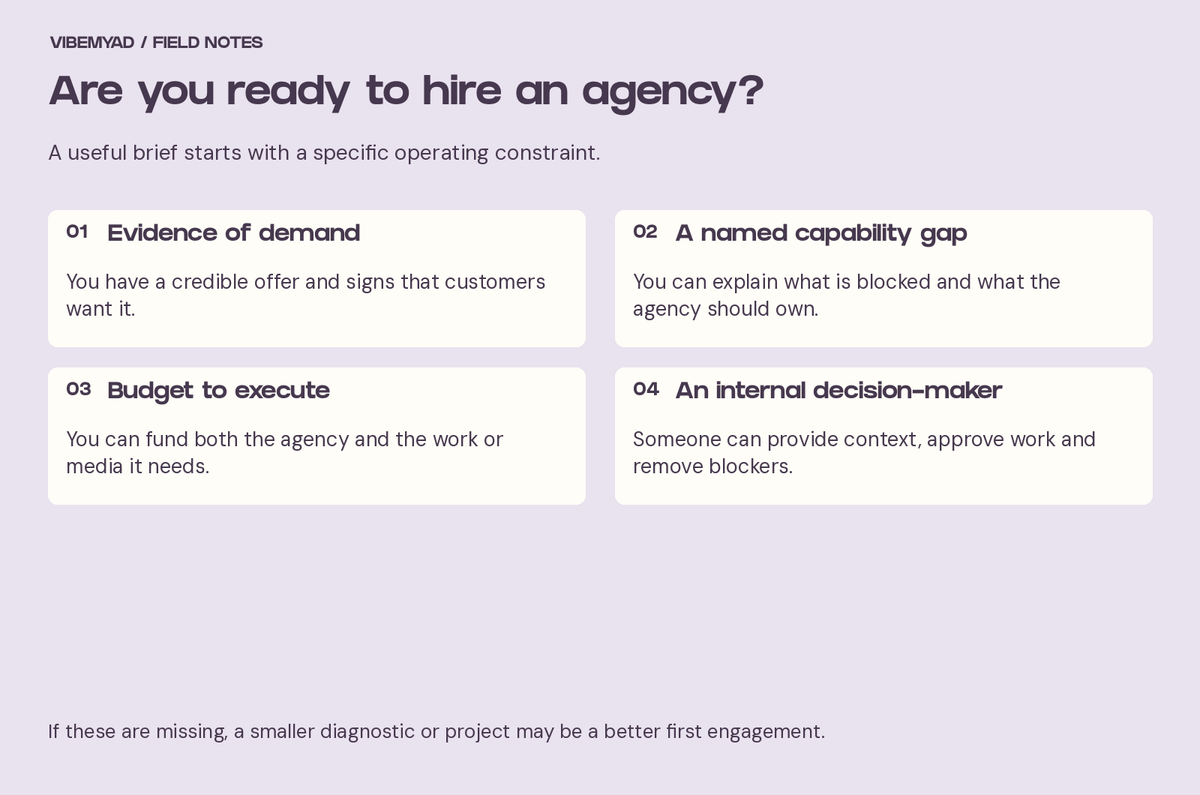
Agency readiness checklist: evidence of demand, a specific capability gap, execution budget and an internal decision-maker.
The strongest signs are operational, not emotional.
A growth plan may need a strategist, media buyer, copywriter, designer, video editor, tracking specialist, and landing-page operator. Hiring one generalist does not create that system.
Our comparison of in-house versus agency marketing shows why equivalent scopes matter. Compare an internal growth pod with an agency team, not one salary with a multidisciplinary proposal.
The team knows what should happen, but campaigns wait for creative, landing pages wait for copy, SEO fixes wait for development, and reports wait for data cleanup.
This is a capacity problem when priorities are clear and the queue keeps growing. An agency can help if it owns delivery, not merely adds another meeting to the queue.
Paid media, lifecycle systems, technical SEO, and analytics become harder as products, markets, spend, and data sources expand. The internal team may understand the business but lack deep operating experience in the channel.
A specialist agency can close that gap. A full-service agency fits when several channels fail at the handoffs between them. Our guide to full-service versus specialist e-commerce agencies helps separate those cases.
Modern paid acquisition needs a continuing supply of concepts, formats, and iterations. If the media buyer spends more time waiting for assets than testing ideas, hiring another media buyer will not solve the problem.
The agency should own research, briefing, production, approval, testing, and learning. The creative agency for ads guide explains what that operating loop should include.
Conflicting platform, analytics, e-commerce, and CRM reports make budget decisions slow. A measurement project may be the first agency engagement.
Google Analytics added custom conversion windows, campaign-data validation, source grouping, and an AI Assistant traffic channel during 2026. Google's current Analytics release notes show how quickly measurement surfaces are changing. An agency should document definitions and changes rather than treating a dashboard as permanent truth.
Founders and marketing heads should still shape positioning, offers, budgets, and priorities. They should not need to resize every ad, rebuild every report, or chase every publishing deadline.
An agency creates value when it returns leadership time without disconnecting the work from business context.
Usually not for scale.
An agency can help research customers, shape positioning, build a launch, or test demand. It cannot make a weak offer desirable through distribution alone. Buying a large media or content program before the product and message show evidence of demand increases the cost of learning.
Use a defined project when uncertainty is high:
• Customer and competitor research
• Offer or positioning sprint
• Measurement audit
• Landing-page diagnostic
• Creative pilot
• Channel feasibility test
The project should end with a decision, not automatically roll into a retainer.
Hire when the business has a conversion event worth optimizing, enough creative and media budget to test, and a clear customer-acquisition target.
The agency should understand contribution margin, refunds, repeat purchase, sales quality, or another downstream measure. Platform ROAS and cost per lead are useful signals, but they are not always business outcomes.
If Meta is the primary channel, read what a Meta ads agency should own. If the business runs on Shopify, the Shopify ads agency guide connects media decisions to store economics, feeds, tracking, and conversion.
Hire when search demand matters to the business and the company can implement technical, editorial, and product changes.
SEO stalls when the agency produces audits nobody ships or articles disconnected from commercial pages. Confirm who handles development, subject review, visuals, internal links, CMS publishing, and content refreshes.
In 2026, search work should also account for AI discovery. That means clear answers, original evidence, strong entities, useful comparisons, and pages that machines can quote without stripping away essential context.
Wait when:
• The product has no evidence of demand.
• The company cannot fund the media or production needed to execute.
• Nobody can approve work or provide business context.
• The goal is "more marketing" rather than a measurable operating change.
• Tracking is broken and the proposed engagement assumes clean attribution.
• The business expects the agency to guarantee outcomes it cannot control.
• Leadership wants an agency to settle an internal strategy disagreement.
Be skeptical of promises made before an agency sees the offer, economics, funnel, data, and constraints. The FTC's guidance for US advertisers requires advertising claims to be truthful, evidence based, and not deceptive or unfair. The same standard is useful when evaluating an agency's own sales claims.
Match the contract to the uncertainty.
Avoid a long contract that begins before the parties can define the work. A short first phase can produce the baseline and operating rhythm needed for a larger engagement.
Ask for evidence about the problem you need solved.
• Who will do the work, by name and role?
• What will ship in the first 30 days?
• Which inputs must the client provide?
• What data and accounts will the agency need?
• How will success and failure be measured?
• What remains outside scope?
• Who owns the assets, accounts, and research?
• What happens if the first hypothesis fails?
• How can either party end the engagement?
The nine-question e-commerce agency checklist expands this diligence for DTC brands.
Vibemyad starts with the outcome and the operating constraint. The agency combines category research, creative production, paid media, e-commerce SEO, AI search, landing pages, and automation when the result requires those functions to work together.
That does not mean every company needs every service. A brand with weak measurement may need a diagnostic first. A company with a strong internal team may need only creative throughput or a specialist channel. A business without a proven offer may need more learning before it needs scale.
Review the Vibemyad agency model to see how the engagement connects execution to an agreed outcome.
Hire when the business has a validated offer, a named constraint, enough execution budget, and an internal owner. Choose a project when the problem is uncertain, a specialist when one function is missing, and an integrated agency when the handoffs between functions are the problem.
If you cannot state what the agency will own and what evidence will change your next decision, wait. The right agency should make the operating system clearer before it makes the invoice larger.
Table of Contents