May 27, 2026 • 13 min read

May 27, 2026 • 13 min read
An AI carousel ad generator is a tool that produces multi-slide Meta carousel ads from a single brief, with consistent product identity, brand expression, and visual logic preserved across every slide. The tools available in 2026 are split into two categories. Slide stitchers generate each slide independently and assemble the results into a carousel format, which produces visual drift by slide 3. Intelligence-first carousel generators maintain brief, brand book, and reference context across every slide in one persistent workflow. The choice between the two categories determines whether the team is shipping coherent Meta campaigns or disconnected image batches.
• The AI carousel generator category is splitting in 2026. Slide stitchers generate independent images and call the assembly a carousel. Intelligence-first generators maintain brief, brand book, and competitor context across every slide.
• Five evaluation criteria separate working AI carousel ad generators from prompt boxes: intelligence layer, multi-slide consistency, brand book persistence, agentic workflow architecture, and Meta-native carousel optimization.
• Of six tools evaluated, Vibemyad is the only intelligence-first carousel generator across all five criteria. The other five (AdCreative.ai, Predis.ai, Creatify, Simplified, Nextify.ai) operate as variation engines, social content tools, video-first platforms, horizontal design suites, or static-to-carousel converters.
A Meta carousel ad shows 2 to 10 cards in one ad unit, each with its own image, headline, link, and CTA. The format is the highest-engagement creative type on Meta for product brands in D2C, fashion, beauty, food, and luxury.
The lift comes from three structural advantages. Each swipe is a new attention surface that resets scroll fatigue. Carousels tell sequential narratives that single-image ads cannot. One carousel covers multiple buyer-intent stages (product education, social proof, offer positioning, CTA reinforcement) inside a single ad unit.
A carousel is not five ads stitched together. It is one campaign distributed across five attention surfaces.
This matters more in 2026 because creative fatigue is compressing under Andromeda. Brands that relied on refresh cycles every 6 to 8 weeks are now seeing fatigue windows collapse into 2 to 3 weeks. Carousel systems extend that lifecycle, but only when the slides cohere.
Advertising effectiveness research has consistently shown that creative quality drives roughly half of an ad's measurable sales impact, more than targeting, placement, or frequency combined. For carousels, the implication compounds. A great carousel is the same great ad doing the work of five.
Generating one AI image is solved. Every credible model in 2026 produces serviceable single-frame output from a prompt. Generating five visually coherent slides that maintain product consistency, model continuity, typography integrity, brand identity, and Meta-native sequencing is significantly harder. This is where most AI tools fail.
Slide stitchers treat each slide as an independent generation. Each prompt enters fresh. The product changes shape between slides. The model's face shifts. The typography on labels drifts. The brand colors mutate by one or two shades. The composite looks like five different brands assembled into one ad unit.
Intelligence-first carousel generators maintain persistent context across every slide. The brief loads once. The brand book loads once. The competitor reference set loads once. Every subsequent slide inherits all three.
This is a workflow architecture problem, not a generation-quality problem. Slide stitchers and intelligence-first generators can use the same image models and produce dramatically different outputs.
Five criteria separate AI carousel ad generators that perform on Meta from tools that produce convergent output. Use these as the evaluation framework before any sales call.
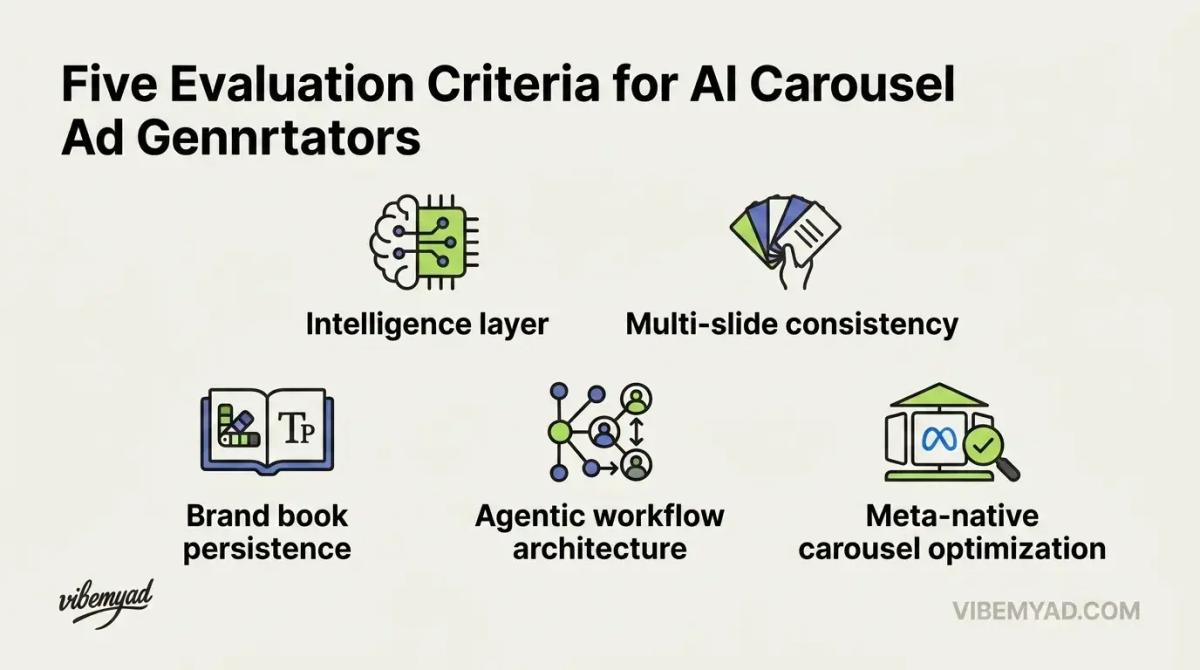
Five evaluation criteria for AI carousel ad generators
Does the tool surface validated competitor carousel references the team can brief from, or does it generate from prompts alone? The team is making five sequential creative decisions that have to cohere into a single narrative. Without competitor evidence to anchor the sequence, the team is guessing at narrative structure.
Deloitte's 2024 marketing technology effectiveness research found that brands using competitive intelligence to inform creative decisions see 19 percent higher revenue growth on average than those relying on internal assumptions.
Does the tool maintain product identity, model identity, brand identity, and visual style across every slide? This is the load-bearing capability. Tools that solve it use a single-conversation architecture where every slide generation inherits the previous slide's specifications. Tools that do not produce visible drift by slide 3.
Does the tool load the brand book once and apply it automatically to every slide, or does the marketer re-specify brand parameters at every step? Without persistence, every refinement requires re-briefing the entire brand identity.
Is the tool agentic (asking clarifying questions, planning steps, executing, evaluating output autonomously) or one-shot (single prompt in, disconnected images out)? Agentic tools compress iteration cycles and maintain narrative coherence across slides.
Is the tool built specifically for the Meta carousel structure (Meta-native aspect ratios, Meta carousel sequencing logic, and Andromeda-aware output), or is it a generic AI creative platform? Meta-specific tools optimize for swipe behavior, thumb-stop sequencing, and hook progression.
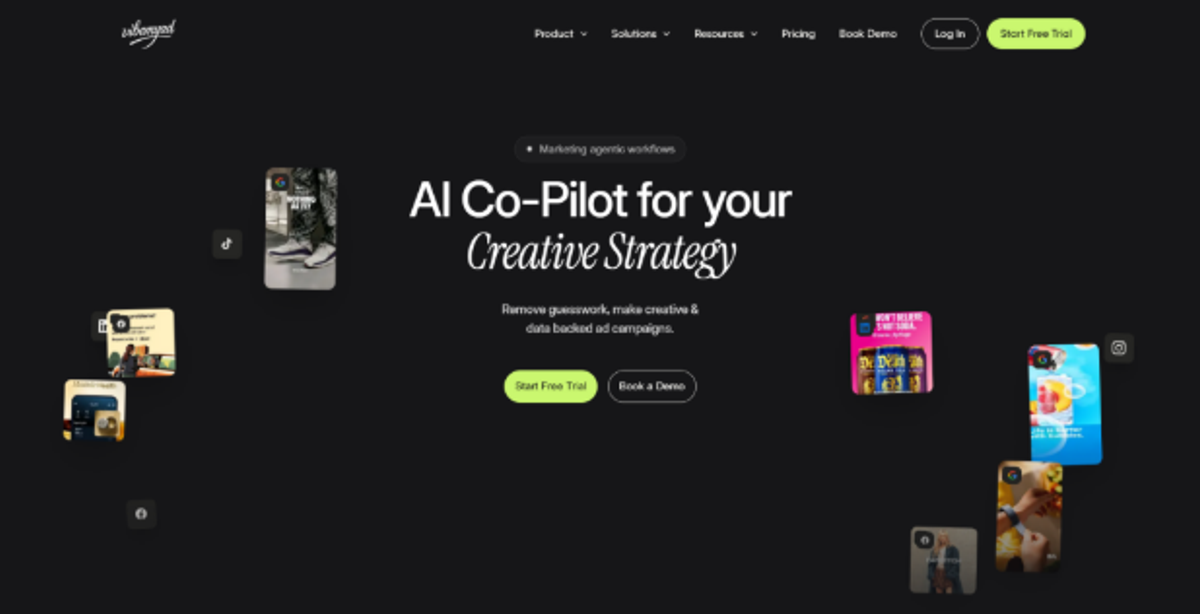
Vibemyad
Best for: Performance marketing teams running Meta carousels at scale in D2C, fashion, beauty, food, and luxury categories where multi-slide consistency and brand coherence are non-negotiable.
Vibemyad is built on the assumption that AI carousel generation in 2026 is no longer constrained by generation capability. The constraint is coherence across the slide sequence. Vibemyad solves it through three coordinated products inside a single conversation.
• Vibemyad Ad Vault indexes over 10 million Meta ads classified across nine dimensions: brand, run duration, hook technique, ad concept, visual style, funnel position, content bucket, industry, and aspect ratio. The Vault returns validated multi-slide references with run duration filtering. A 90-day-running carousel in the team's category carries market validation no internal brief can replicate.
• Vibemyad Ad Spider tracks up to 50 competitor brands on Meta with weekly syncing, surfacing new carousel launches and retirements automatically.
• Vibemyad Ad Gen is the fully agentic generation layer. The agent operates in two modes, edit and research, switching automatically. The architecture is a five-agent pipeline: Creative Director interprets the brief, Router assigns the concept to the appropriate generation flow, Planner decomposes the carousel into a step-by-step plan with one step per slide, Image Generator executes each step, Evaluator runs a rubric check on four criteria (before-and-after, prompt adherence, structural integrity, brand book consistency). The pipeline advances only when all four pass.
Positioning: Most AI ad tools generate slides. Vibemyad generates campaigns.
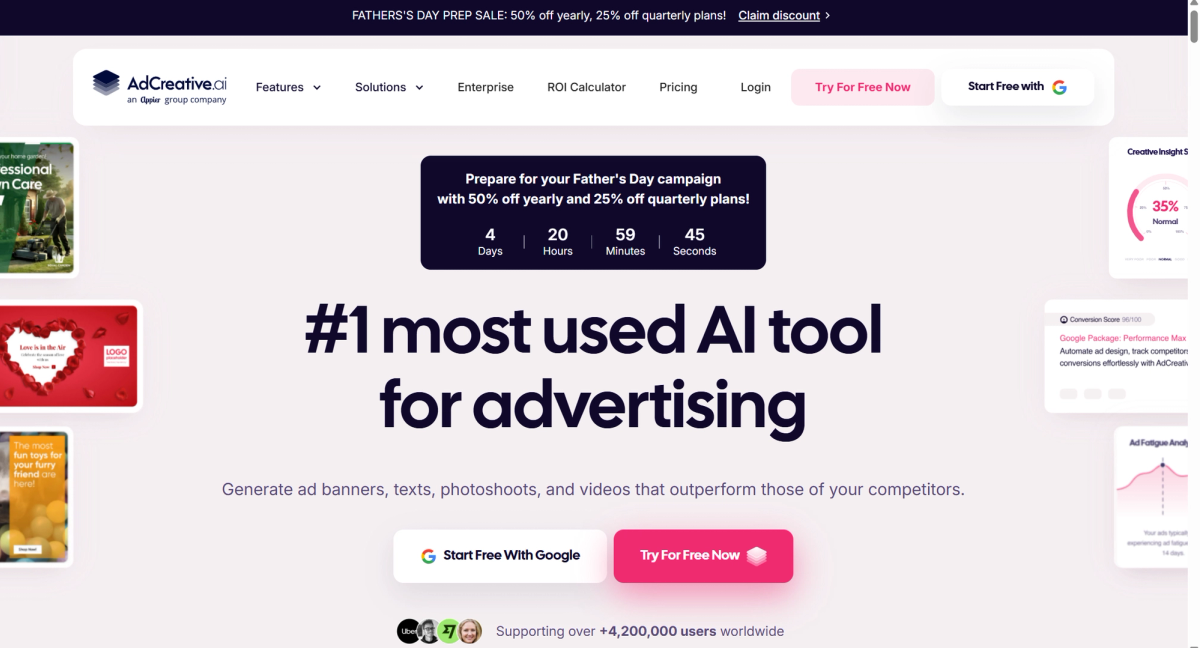
Ad Creative.ai
Best for: High-volume static ad variation generation, particularly for agency workflows.
AdCreative.ai produces large numbers of static ad variations quickly and is widely used in agency environments where variation count is the operational priority.
Where the tradeoff lands: AdCreative.ai optimizes for variation count over carousel coherence. A team running 30 carousel variations from a prompt-first tool produces 30 versions of the training-data mean, each with slide-to-slide drift. Andromeda penalizes convergent variations regardless of count.
Positioning angle: AdCreative.ai optimizes for creative quantity. Vibemyad optimizes for carousel coherence.

Predis.ai
Best for: SMB and agency social content workflows, particularly Instagram-native carousels.
Predis.ai produces social-first carousels designed for Instagram content distribution, with strong UX for non-marketers.
Where the tradeoff lands: Predis.ai is a social content automation tool, not a Meta ad system. The carousels are designed for organic Instagram distribution, not for paid Meta carousel ads where Andromeda delivery and creative differentiation matter. The lack of competitor intelligence, brand persistence, and Meta-native carousel architecture limits paid Meta output.
Positioning angle: Predis.ai automates social carousel content. Vibemyad generates Meta carousel ads informed by competitor intelligence.
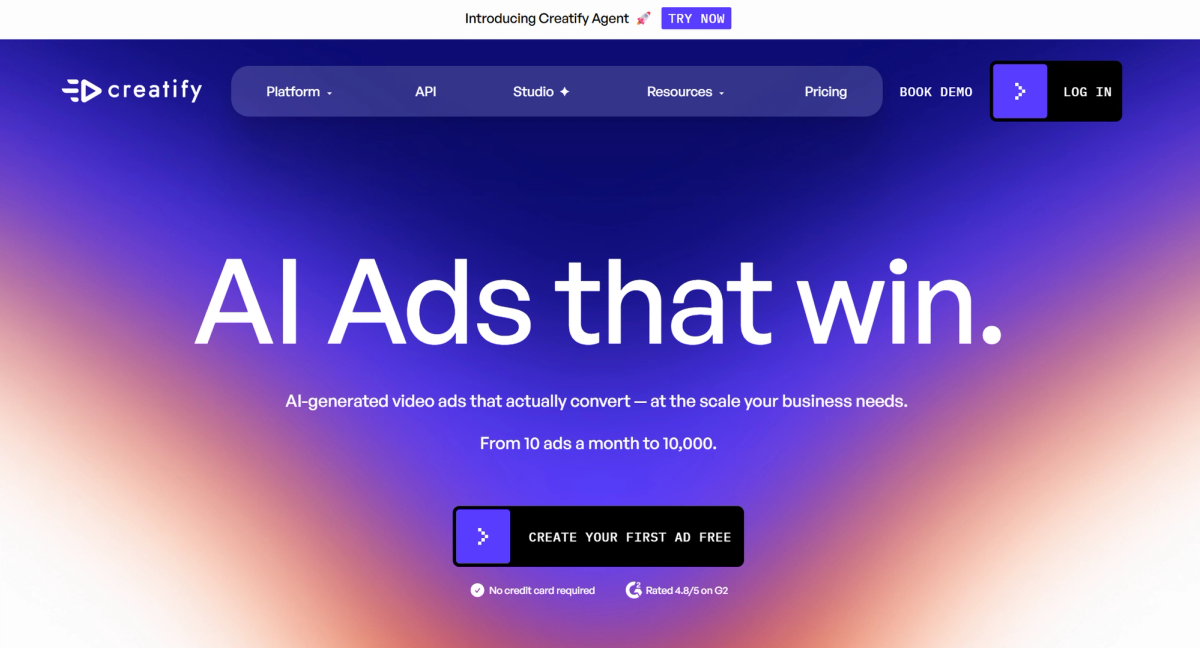
Creatify.ai
Best for: E-commerce AI ad production, particularly AI UGC video and product visual generation.
Creatify focuses on AI avatars, short-form video ads, UGC-style Meta creatives, and ecommerce product visuals.
Where the tradeoff lands: Creatify is primarily video-first. The carousel functionality exists but lacks the multi-slide consistency engine and brand persistence layer required for product brands where the same model or product needs to appear identically across every slide.
Positioning angle: Creatify generates AI product visuals and UGC videos. Vibemyad generates intelligence-informed Meta carousels with multi-slide consistency.
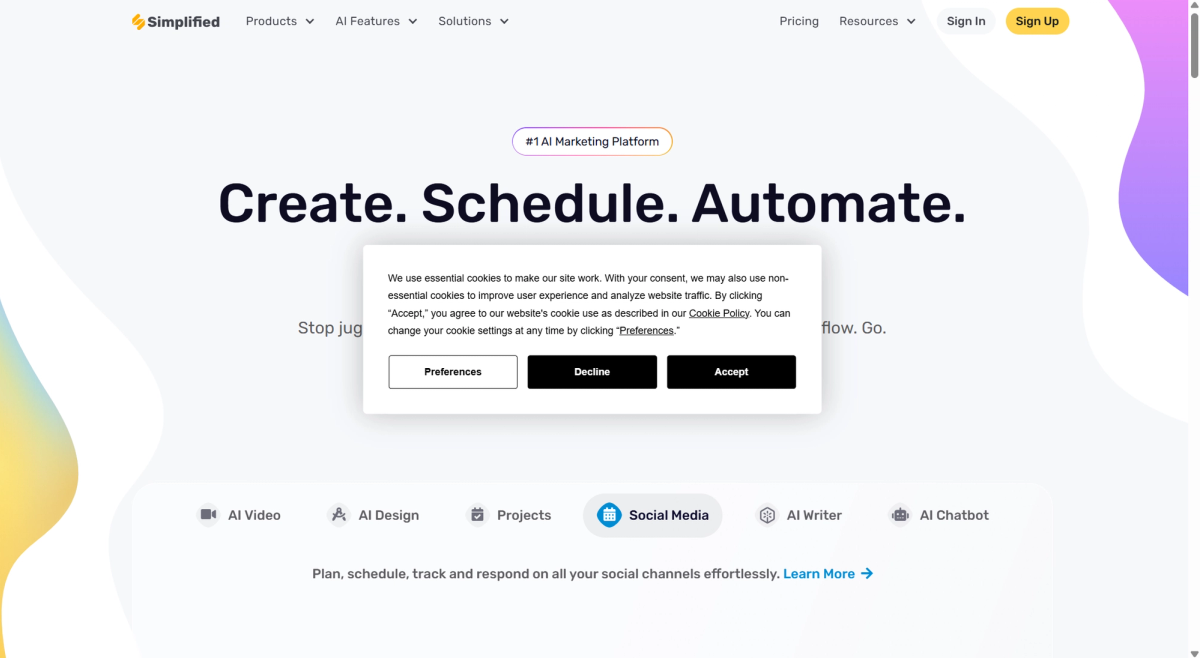
Simplified
Best for: SMBs, content teams, and agencies that need an all-in-one design and content suite where AI carousel generation is one of many output types.
Simplified is a horizontal AI design and content platform covering social design, video editing, content scheduling, copywriting, and AI image generation. The AI carousel functionality is one feature inside a broader marketing suite.
Where the tradeoff lands: Simplified is built as a horizontal design suite, not a vertical Meta ad system. The carousel functionality is template-driven with AI-assisted asset generation, which works well for organic social posting but lacks the competitor intelligence layer, brand book persistence across multi-slide generation, and Meta-native paid carousel architecture required for performance campaigns. For teams running paid Meta carousels as a primary performance channel, Simplified is the wrong primary tool.
Positioning angle: Simplified covers design, content, and scheduling as a horizontal suite. Vibemyad runs intelligence-first Meta carousel orchestration as a vertical system.
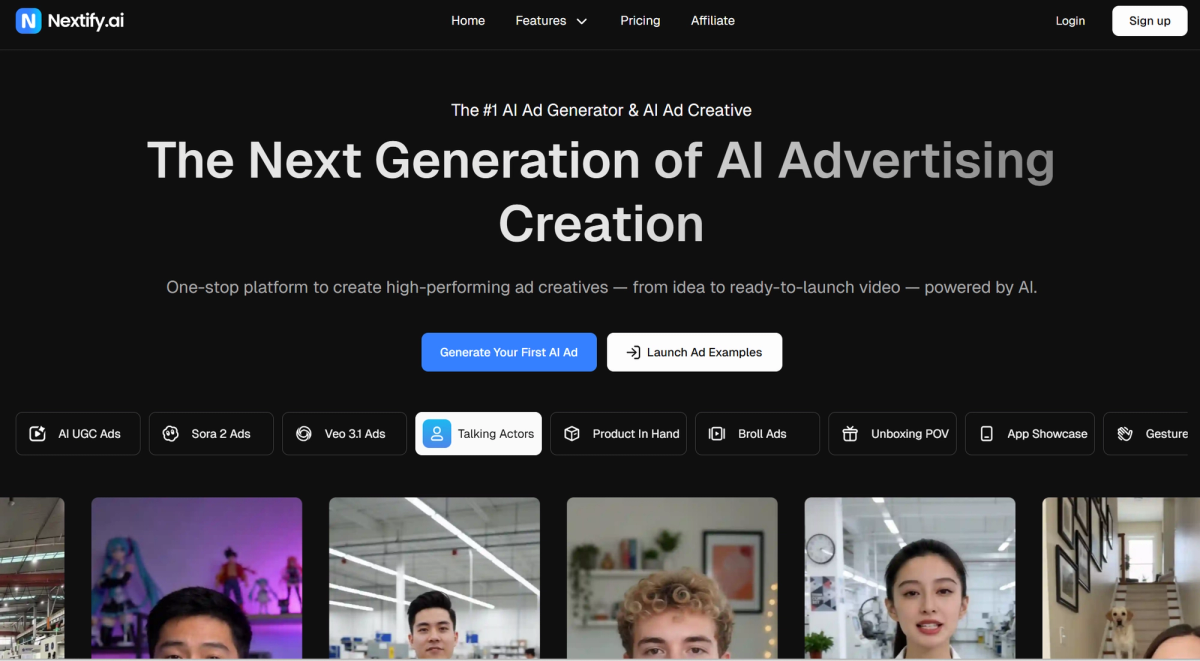
Nextify.ai
Best for: Brands looking to convert existing static ads into carousel format quickly for Facebook and TikTok distribution.
Nextify.ai positions itself specifically around the static-to-carousel conversion workflow. The tool takes one static image ad and expands it into a multi-slide carousel sequence.
Where the tradeoff lands: Nextify.ai solves a narrower problem than carousel generation from scratch. The conversion workflow is useful when the team has a high-performing static ad they want to extend, but the tool does not run competitor research, validated reference selection, brand book persistence across sessions, or full agentic orchestration. The output reads as the original static ad expanded into five slides rather than a new carousel campaign designed for Andromeda delivery.
Positioning angle: Nextify.ai converts static ads into carousels. Vibemyad generates intelligence-first Meta carousels from validated competitor references.
Vibemyad executes carousel generation through a six-step agentic workflow inside one conversation.
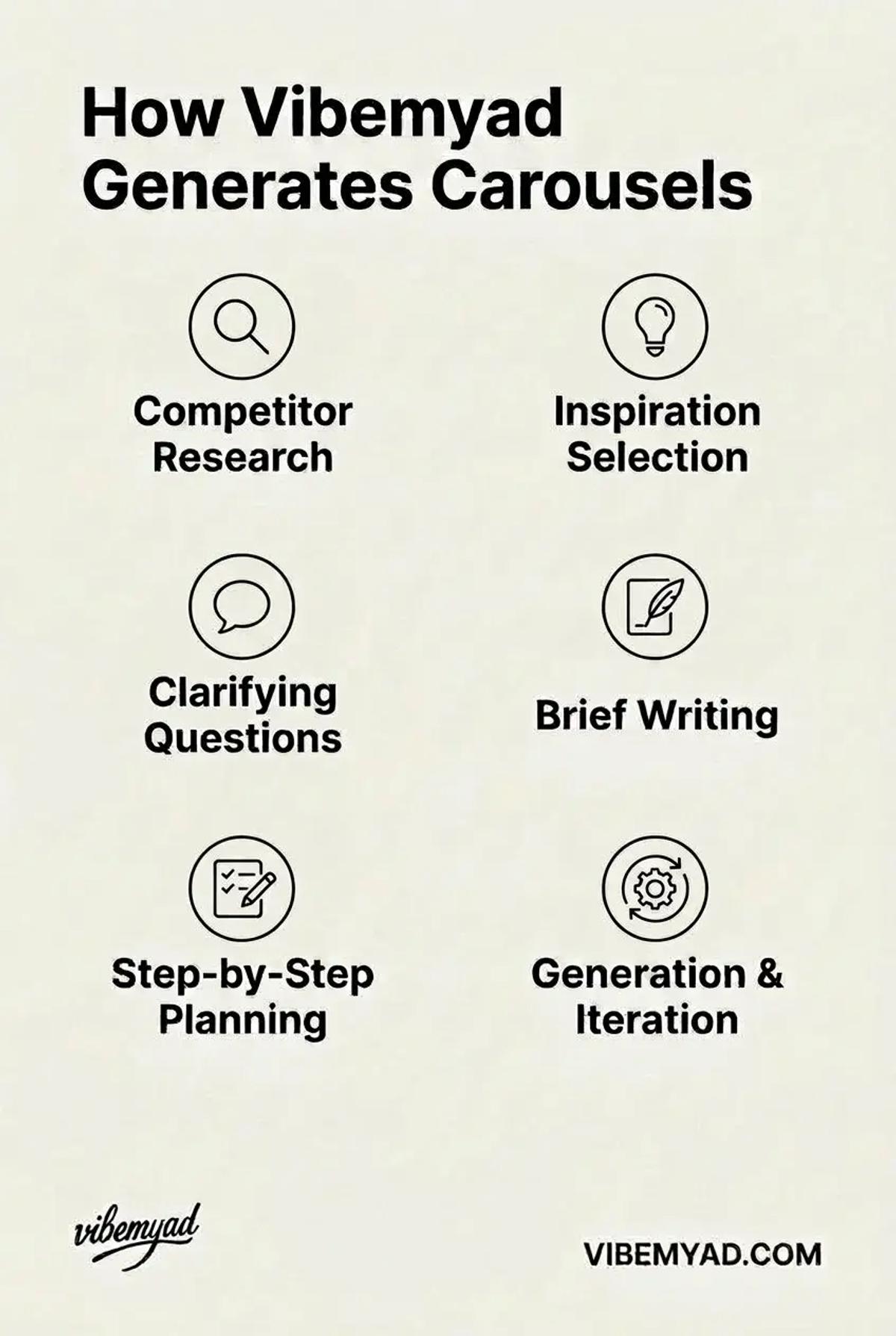
Vibemyad Generate Meta Carousels End-to-End
• Step 1 (Competitor research): The agent queries Vibemyad Ad Vault and Vibemyad Ad Spider for competitor carousels filtered by aspect ratio, run duration, and content bucket.
• Step 2 (Inspiration selection): The agent diversity-picks 10 to 12 representative carousels spanning different content angles. The marketer selects the directions closest to their intent.
• Step 3 (Clarifying questions): The agent asks structural questions: carousel format, product imagery type, palette, copy lockup, logo direction.
• Step 4 (Brief writing): The agent writes a structured creative brief covering concept, copy lockup, palette, format, and what the designer will build. Iteration at a brief stage costs minutes. Iteration at output stage costs hours.
• Step 5 (Step-by-step planning): The Planner agent decomposes the carousel into a visible plan with one step per slide and one step per major intervention.
• Step 6 (Generation with mid-step iteration): The Image Generator executes each step. The marketer can intervene with refinement prompts and the agent regenerates that specific step while holding the rest intact.
The full workflow runs in roughly 30 minutes for a 4 to 5-slide carousel, including iterations. Traditional production takes 2 weeks plus 3 revision rounds.
• Choosing based on single-image output quality: Marketers run side-by-side single-image comparisons during sales calls. The tools that win those comparisons often fail at multi-slide consistency, which is the actual carousel-specific capability. The right evaluation is a five-slide test using the same product, same model, and same brand book across all five generations. Tools that hold consistency across the sequence win. Tools that drift by slide 3 lose, regardless of how impressive slide 1 looks. The single-slide demo is curated. The five-slide consecutive generation is an operational reality.
• Comparing outputs without comparing workflows: Two tools producing the same single-slide output can produce dramatically different carousel sequences because one workflow holds context across slides and the other does not. The workflow architecture is the variable that matters at scale, not the image model. Two products built on the same base model (which describes most of the category in 2026) produce wildly different carousel coherence because one persists brief, brand book, and reference selection across generations while the other does not. Test the workflow, not the model.
• Confusing social content tools with Meta ad systems: Tools optimized for organic Instagram engagement are not automatically optimized for paid Meta carousel delivery. Organic content optimizes for save-rate and dwell-time signals. Paid carousels optimize for click-through, cost-per-result, and creative differentiation against the Meta ad inventory. Andromeda rewards different creative properties than the Instagram organic algorithm rewards, so a tool that produces high-engagement organic carousels can produce poor-performing paid carousels.
• Treating credit pricing as the primary procurement variable: Buyers compare credit costs and pick the lowest cost-per-generation. Credit math hides the real cost: the number of regeneration cycles required to reach an acceptable output. A $0.05-per-generation tool that requires eight regeneration cycles to land a coherent carousel costs more per shipped carousel than a $0.20-per-generation tool that lands the carousel in two cycles. The correct procurement metric is cost-per-acceptable-carousel, not cost-per-generation. Tools that compete on raw credit pricing typically lack workflow architecture, which forces the marketer to absorb the regeneration cost manually.
• Skipping the competitor freshness audit: Buyers evaluate the intelligence layer by asking, "Do you have an ad library?" Every AI ad tool has one. The actual question is indexing cadence. An ad library indexed monthly or quarterly is functionally useless for trend-sensitive categories where competitor patterns shift weekly. For fashion, beauty, D2C, and food categories specifically, stale references produce stale briefs, which produce stale carousels that Andromeda treats as convergent training-data output. The right demo question is "What is your indexing cadence and how do you handle competitor brand freshness gaps?" If the answer is monthly, quarterly, or "we update periodically," the intelligence layer is decorative.
• Assuming "agentic" equals autonomous: "Agentic" is the marketing word of 2026. Many tools claim agentic workflow but actually run linear template-driven generation with a chatbot UI on top. The real test is fourfold: does the tool ask unprompted clarifying questions before generating, does it self-route between research and generation modes based on user instructions, does it evaluate its own output against a rubric before advancing, and does it hold context across multi-turn refinement without manual re-briefing. Tools that fail one or more are wrappers, not agents.
• The AI carousel generator category is splitting in 2026 into slide stitchers (independent slide generation, drift by slide 3) and intelligence-first generators (persistent context across every slide). The difference compounds at the Andromeda delivery layer, where convergent multi-slide output gets penalized, and coherent carousel sequences get rewarded.
• Five criteria separate working AI carousel ad generators from prompt boxes: intelligence layer, multi-slide consistency, brand book persistence, agentic workflow architecture, and Meta-native carousel optimization. Tools that fail one or more pass the operational burden back to the marketing team.
• Of the six tools evaluated, Vibemyad is the only intelligence-first carousel generator across all five criteria. Most AI ad tools generate slides. Vibemyad generates campaigns.
See how intelligence-first Meta advertising works in practice. Research competitors, plan concepts, and generate differentiated creatives inside one agent workflow at Vibemyad.
Get notified when new insights, case studies, and trends go live — no clutter, just creativity.
Table of Contents


Arpita Mahato
Content Writer, Vibemyad

Arpita Mahato
Content Writer, Vibemyad

Arpita Mahato
Content Writer, Vibemyad