September 01, 2026 • 17 min read
September 01, 2026 • 17 min read
A Shopify ads agency manages paid acquisition for a Shopify store across Meta Ads and Google Ads, and connects those campaigns to the store's tracking, product feed, creative pipeline, landing pages, and contribution margin. The distinguishing work is not campaign management. It is making the store's own data good enough for the platforms to optimize against.
Raising a Shopify store's ad budget is easy. Raising it without wrecking acquisition efficiency is not. The constraint is rarely a campaign setting. A store can have competent media buying and still stall because its ads repeat one idea, its product feed sends thin information to Google, its purchase events stopped reporting after a checkout upgrade, or its margin cannot support what a new customer now costs.
That last point has numbers behind it. Triple Whale's Facebook ad benchmarks for August 2025 through July 2026, drawn from more than 40,000 brands, show CPM up 13.24 percent year over year to $15.06 and click-through rate up 15.97 percent, while conversion rate fell 4.73 percent and return on ad spend stayed flat at 1.88. Traffic got more expensive and more engaged. It did not convert better. Efficiency now has to come from somewhere other than the auction.
A Shopify ads agency plans, launches, measures, and improves paid campaigns that send customers to a Shopify store, usually across Meta Ads, Google Ads, and YouTube, and sometimes TikTok or Pinterest.
The narrow version of the job is budgets, bids, audiences, and reports. The useful version is wider. It translates margin and inventory data into acquisition targets, builds a steady pipeline of genuinely new ad concepts, configures and validates the Meta Pixel and Conversions API, improves Google Merchant Center product data, matches each campaign to the right product page or bundle, reconciles platform reporting against Shopify orders, and turns test results into the next round of ads.
Start with a definition the store and the agency can both agree on. Shopify's own documentation on measuring marketing performance defines customer acquisition cost as "the total amount spent on advertising and sales divided by first-time customers attributed to the campaign," which is a firmer starting point than blended revenue or platform ROAS. The same reports let merchants switch between five attribution models, including last click, first click, any click, and linear, which is a reminder that no single attribution view is the truth.
Paid media does not repair weak economics. It makes them visible faster.
Take a store selling a product for $80. After discounts, cost of goods, fulfillment, payment fees, and expected returns, it keeps $34 before advertising. A reported $25 customer acquisition cost looks healthy against that. Add agency fees, creative production, and the reality that not every buyer comes back, and the room to scale is thinner than the ad dashboard suggests.
This is why the first useful agency conversation is about allowable CAC rather than target ROAS. A ROAS target is a platform number. Allowable CAC is a business number, and it is the one that decides whether a budget increase is growth or a slow leak.
For a first-order view, break-even CAC is net revenue minus cost of goods, minus fulfillment, minus payment fees, minus variable operating costs. If repeat purchases are reliable, a brand can spend above first-order break-even and recover the difference later. Projected lifetime value is not cash in the bank, though, so a good agency separates observed repeat revenue from hoped-for retention and states the expected payback period out loud.
That distinction changes budget decisions more than most creative choices do. A store with a 30-day payback window can recycle cash roughly six times a year. A store waiting six months cannot, even when both report the same lifetime ROAS.
Benchmarks help set expectations here, as long as they are read as ranges rather than targets. Polar Analytics, which publishes medians from more than 4,000 Shopify brands, puts store conversion rate between 1.43 percent and 3.09 percent depending on industry, new-customer ROAS between 1.47x and 5.16x, and customer acquisition cost between $22 and $84.22. A store sitting outside those ranges is not automatically broken, but it is worth explaining before anyone raises spend.
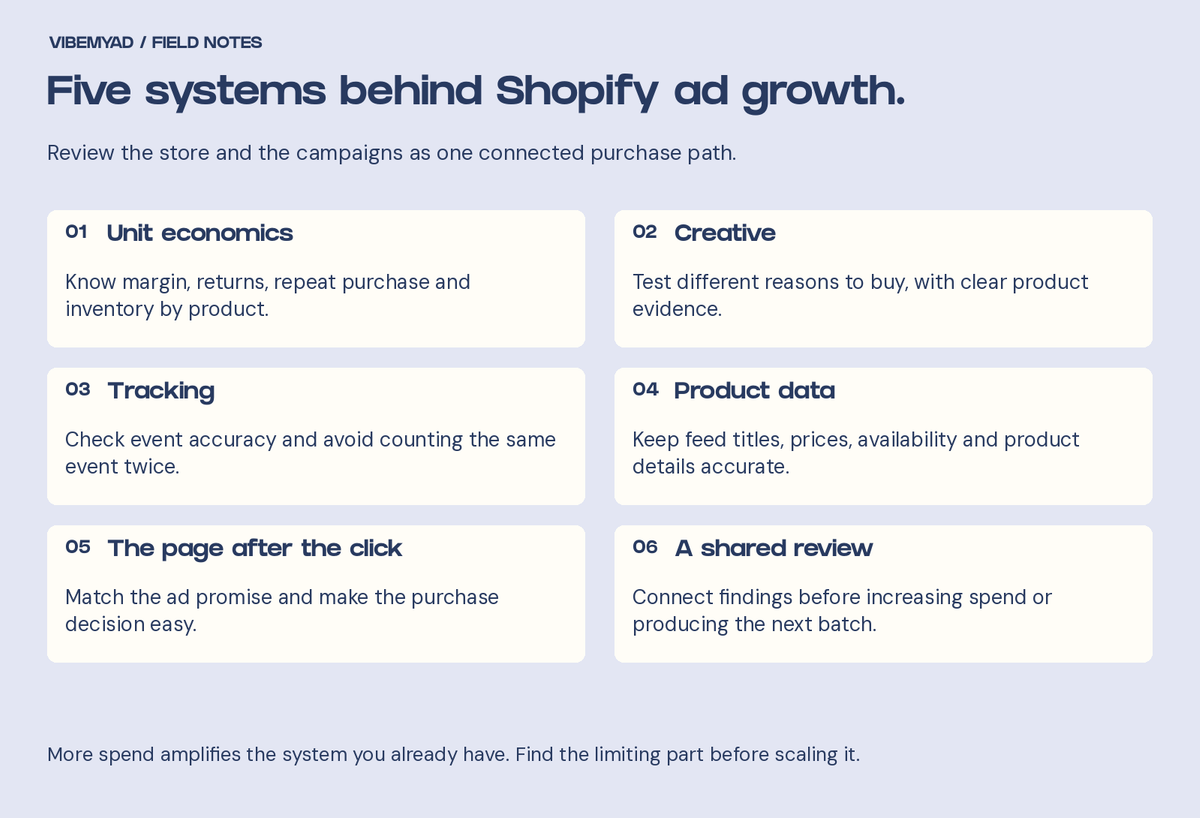
Shopify ads checklist: unit economics, creative, tracking, product data and the landing page, reviewed together.
Scale is a system property, not a campaign property. Five things set the ceiling, and paid media can only work inside them.
Before campaigns scale, an agency needs product-level answers. Which SKUs produce the highest contribution margin after returns. Which products lead to a second purchase. How much discounting the margin tolerates. Whether bundles raise average order value or simply pull revenue forward. Whether inventory can absorb a sudden increase in demand.
Revenue is a poor guide to these questions. A bestseller with a high return rate can be worth less than a quieter product that reliably creates repeat customers, and only the second one deserves prospecting budget.
Meta finds buyers more effectively when it receives enough conversion signal and a range of ads that give different people different reasons to care. That makes creative production part of media buying rather than a request sent to design after performance drops.
There is a real mechanism underneath this. Meta's engineering team published Andromeda in December 2024, a retrieval system whose job is "selecting ads from tens of millions of ad candidates into a few thousand relevant ad candidates," and reported a 6 percent recall improvement and an 8 percent ads quality gain on selected segments. Worth being precise about what that does and does not say: Meta documented the retrieval engine, not an instruction to advertisers. The widely repeated corollary that Andromeda obliges brands to ship far more distinct creative is an industry inference, and it should be described that way rather than quoted as Meta guidance.
What is directly attributable is scale. Meta told investors on its second quarter 2026 earnings call that Advantage+ end-to-end solutions reached over $75 billion in annual revenue run rate, with ad impressions up 14 percent and average price per ad up 12 percent year over year. More automation, more competition, higher prices.
A useful test therefore changes a meaningful variable: the customer problem, the product mechanism, the proof, the offer, the format, or the opening hook. Changing a background color is not a hypothesis, and neither is producing ten near-identical creator scripts. A skin care brand can test one offer through a founder explanation, a close product demonstration, a customer objection, and an ingredient mechanism, then test hooks, lengths, and talent inside whichever angle wins. Shopify's guidance on optimizing Facebook ads makes the same point plainly, noting that "testing a single variable makes it easier to identify what's actually driving results."
Vibemyad builds that pipeline from competitor research and live performance patterns. Our guide to using the Meta Ad Library covers how to study positioning and format without copying another brand's execution, the ad hook formula that raised CTR by 180 percent covers turning customer language into testable openings, and our creative testing framework covers how to structure the tests so the results mean something.
The Meta Pixel records browser events. The Conversions API, in Meta's own developer documentation, "is designed to create a connection between an advertiser's marketing data" from a server, website platform, mobile app, or CRM "to Meta systems that optimize ad targeting, decrease cost per result and measure outcomes." Meta's best-practice guidance recommends running it "in addition to the Meta Pixel" and sharing the same events through both tools, which only works if event names and event IDs match so Meta can deduplicate.
For a Shopify store, an agency should verify that ViewContent, AddToCart, InitiateCheckout, and Purchase fire correctly, that purchase values and currencies match the order, that browser and server events deduplicate rather than double-count, that test orders stay out of reporting, that UTMs follow one naming convention, that consent settings match the markets the store sells into, and that Shopify, Meta, Google Ads, and analytics are compared on the same date range and revenue basis.
Expect disagreement between those numbers and plan for it. Shopify documents that customer and session counts differ across its own reports because of how sessions are cookied and timed out, and notes that where a cookie banner is active, "data is collected from visitors from those regions only after obtaining consent," which reduces the data available for analytics and marketing. Shopify's pixel migration documentation goes further and says that because some bots do not trigger the web pixel sandbox, "single-digit percentage dips in event counts are expected." That sentence is worth keeping on hand. It explains a step down in platform-reported conversions that has nothing to do with sales.
Tracking will not make attribution exact. It will make optimization less blind.
Google Shopping and Performance Max depend heavily on what Merchant Center receives. Google's product data specification states that "Google uses this data to match your products to the right queries, and as a foundational input to help optimize and enhance the content of the ads being served in our AI powered formats and experiences," and separately that accurate, correctly formatted product data is essential for creating successful ads and free listings and for preventing disapprovals.
A Shopify PPC agency should therefore treat feed work as campaign work: rewriting titles around the attributes shoppers actually use, fixing variant and identifier errors, building product types and custom labels that support segmentation, excluding products that cannot carry acquisition spend, keeping price and availability synchronized, and testing product-first images that stay legible in Shopping placements.
Two dates matter here. Google sunset the Content API for Shopping on August 18, 2026, so any feed tooling still built on it needs to be on the Merchant API. And from January 31, 2027, Merchant Center raises the minimum image resolution to 500 by 500 pixels across all product categories, with warnings already appearing since April 2026. That is a catalog project, not a campaign tweak, and it takes longer than most teams assume.
Performance Max itself gives access to "all Google Ads inventory, including YouTube, Display, Search, Discover, Gmail, and Maps, from a single campaign," per Google's own overview. Reach that wide makes clean inputs more important, not less.
An ad can win attention and still send the customer into a poor buying experience.
The landing page should continue the promise the ad made. If the creative sells a starter bundle, the click should not land on a generic collection. If the ad answers a durability objection, the product page should make that proof easy to find. Mobile load speed, photography, reviews, shipping and returns information, subscription terms, and checkout friction all decide how much the brand can afford to pay for traffic.
An agency does not need to redesign the store every week. It does need to diagnose whether the campaign, the offer, or the page caused the loss. Otherwise the media buyer keeps changing audiences to solve a merchandising problem.
Meta and Google usually play different roles in a Shopify account. Meta is strong at creating demand through visual stories, demonstrations, and repeated exposure. Google captures demand that already exists through Search and Shopping, while YouTube and Performance Max can reach customers earlier.
The split should follow buying behavior rather than a fixed percentage.
The point is not to split spend evenly. It is to stop judging both channels by the same last-click report. Shopify's marketing reports expose attribution controls on performance by referring channel, by marketing activity, and by UTM campaign, which is the cheapest way to see how the two channels actually cooperate. Our comparison of Google Ads and Facebook Ads ROI goes deeper into where each one earns its budget.
For Search cost context, WordStream's 2026 Google Ads benchmarks, based on 13,474 United States search campaigns between April 2025 and March 2026, report a median cost per click of $5.42 and a median click-through rate of 6.64 percent across all industries. Those medians lean toward lead generation, so treat them as cost context rather than as an ecommerce conversion target.
Several things that most agency proposals still describe incorrectly. This is the section to test a prospective agency against, because every item below is dated and checkable.
Three of those deserve explanation.
Checkout tracking broke quietly. Shopify's checkout.liquid documentation confirms the sequence, and the failure mode is silence rather than an error. The store keeps selling while the receipt page stops reporting. Shopify's checkout extensibility upgrade guide adds a detail that matters specifically to paid media: personally identifiable information is no longer accessible through additional scripts, which degrades the hashed email and phone matching that Meta's Conversions API and Google's enhanced conversions depend on. Match quality can fall even when the purchase event still fires. Shopify also states that custom pixels run in a lax sandbox and that "adding and using custom pixels is unsupported by Shopify," so this is work that needs an owner.
Performance Max is no longer a black box, but it is still not steerable. Google added full search terms reporting, channel-level reporting with data available for any date range after June 6, 2025, asset-level impressions, clicks and cost, up to 10,000 negative keywords per campaign, and first-party audience exclusions. The accurate criticism now is not opacity. It is that Google states directly that "you can't directly control budget allocation per channel." An agency still describing Performance Max as unknowable has not looked at it since 2024.
AI Max replaced the Dynamic Search Ads path. Google launched AI Max for Search campaigns in May 2025 and reported that early testers saw roughly 14 percent more conversions or conversion value at a similar cost per acquisition, measured against campaigns not using it. It left beta in April 2026, and Google's April 2026 announcement set the migration path, recommending advertisers transition now "to maintain full control over your campaign setup."
One more shift belongs here even though it is not a paid channel yet. Shopify's own platform data from the first quarter of 2026 reports that AI-referred sessions convert at nearly 50 percent higher rates than organic search, carry 14 percent higher average order values, and that AI-referred orders grew nearly 13-fold year over year. Shopify also notes that organic search still refers more sessions than all tracked AI platforms combined, and does not disclose sample size, so treat this as fast growth from a small base. There is no ad auction in that channel today. There is a growing share of revenue that standard Meta and Google attribution does not see, which is one more reason to reconcile against Shopify order counts rather than platform dashboards.
Days 1 to 30, repair the inputs. The first month should produce a measurement baseline, not a budget increase. Audit tracking, product feeds, campaign structure, search terms, creative history, landing pages, margin, inventory, and customer cohorts. Define break-even CAC and a target CAC range. Build a creative matrix around customer problems, mechanisms, proof, and offers.
Days 31 to 60, test for information. Launch controlled creative tests on Meta and feed or query improvements on Google, and hold structure steady long enough to learn something. Record which concept, audience temperature, product, page, and offer each test used. The output should be decisions: which angles to expand, which products to stop funding, which landing page objections need work, and which queries reveal stronger intent.
Days 61 to 90, scale proven combinations. Increase budgets where the store has enough conversion signal, creative depth, inventory, and margin to support it. Produce variations around winning concepts before they fatigue. Shift spend by marginal customer acquisition cost and contribution margin rather than by the prettiest platform ROAS. Scaling should feel controlled. If a 20 percent budget increase breaks the economics, find the constraint before doubling anything.
The useful questions reveal how an agency thinks when the dashboard gets messy.
• How do you calculate allowable CAC for each product or category?
• Who owns creative strategy and production, and how many genuinely new concepts ship each month?
• How do you validate Meta Pixel and Conversions API events, including deduplication?
• Where does our purchase event live now that additional scripts are gone?
• Who manages Merchant Center disapprovals and product feed improvements?
• How do you reconcile Meta, Google, and Shopify when the numbers disagree?
• Which metric triggers a budget increase, a reduction, or a pause?
• How do you account for returns, discounts, new customers, and repeat purchases?
• What access, approvals, and assets do you need from our team?
• What will you change if CAC rises while platform ROAS looks stable?
Weak answers stay inside the ad account. Strong answers connect advertising to store economics and explain the tradeoff in plain language. The question about where the purchase event lives is the fastest filter of the ten, because an agency that has not opened a Shopify store since August 2025 will not have an answer to it.
Usually when the store already has product demand but the team cannot sustain the pace of analysis, creative production, and channel management that scaling requires.
It is too early when the product still lacks a clear buyer, margins are unknown, fulfillment is unstable, or the store has not converted enough traffic to prove the offer works. A focused audit or a short project will do more good than a retainer in that situation. Shopify's guidance on hiring a marketing agency draws a similar line, noting that a freelancer suits "a single channel or a defined project" while an agency is better "when you need multiple specialties" and a consistent testing cadence. If pricing structure is the open question, our breakdown of retainer versus outcome-based agency pricing covers the tradeoff, and what a Shopify marketing agency actually operates covers the broader category this one sits inside.
Vibemyad is an AI-native marketing platform and agency for ecommerce teams, working mostly with United States direct-to-consumer brands on Shopify. Our agency model combines competitor research, ad strategy, creative production, campaign management, and ongoing analysis, and we price against the outcome rather than a retainer.
The structural difference is that we own the software instead of licensing it. Our platform watches live category advertising and tags what it finds by hook, format, offer, and funnel position, and that read feeds creative, media, and site decisions. Machines produce. People choose which customer tension matters, whether a claim is credible, and what a result means for the next round. More ads only help when they test better ideas.
For teams comparing operating models, our honest look at whether AI marketing agencies are worth it explains where an AI-native agency creates leverage and where it does not, and the Vibemyad agency page covers how engagements are structured when creative volume, paid media, or both have become the constraint.


Arpita Mahato
Content Writer, Vibemyad

Arpita Mahato
Content Writer, Vibemyad

Arpita Mahato
Content Writer, Vibemyad
Table of Contents