November 05, 2026 • 7 min read
November 05, 2026 • 7 min read
If your Meta ads slowed down this week, I would not start by rebuilding the account. I would first check what changed in your own business: the offer, the creative, the landing page and the quality of the purchases coming through.
An algorithm announcement can explain a change in the advertising system. It cannot, on its own, explain what happened to your sales.
Meta published its latest Andromeda engineering update on October 28, 2026. Here is what the announcement actually says, where the performance claims stop, and how I would turn the discussion into a useful creative test.
Already looking for the basics? Our foundational Andromeda guide covers the broader topic. This article focuses on the October 2026 announcement.
In Meta's October 28 engineering post, Andromeda is the retrieval stage: it shortlists eligible ads before more detailed ranking.
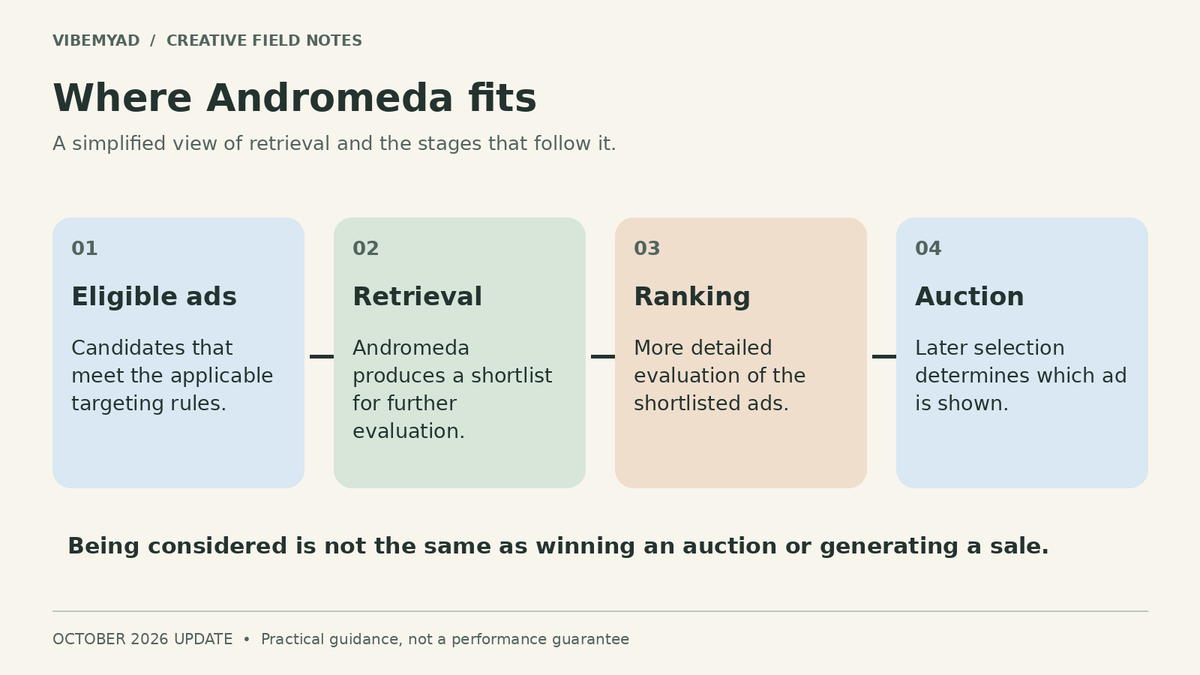
A simplified explanation of retrieval and later selection stages. Being shortlisted does not guarantee delivery or sales.
Meta reports three infrastructure changes: specialized user models with routing between them; roughly 300 times fewer inference-time FLOPs than its 2024 retrieval model; and colocated matching, scoring and selection, reducing network traffic by about 100 times.
The production pipeline scores every eligible ad in its candidate pool at over one billion ads per second on a single GPU server. These are system-efficiency figures, not improvements promised to your ROAS.
Meta describes benefits as automatic. Its post does not establish October 28 as a universal rollout date, prescribe an advertiser activation step, or call the system “Andromeda 2.0.”
Meta attributes a 2.4% increase in Facebook conversions since 2025 to Andromeda. The engineering post does not provide enough experimental detail to reproduce that result. It is a Meta-reported aggregate, not an independently verified result from Vibemyad client accounts.
I would not put a 2.4% uplift into a client's forecast on that basis. A forecast needs the account's own acquisition costs, order values and margins. Even a genuine improvement across a platform can leave individual advertisers with very different outcomes.
My practical recommendation is to inspect the argument behind each ad. If five ads all say the same thing, changing their backgrounds does not test five reasons to buy.
That does not make design variations useless. A clearer crop or a more readable headline may be exactly what an established concept needs. The question is whether you are refining how you communicate a benefit or investigating which benefit matters.
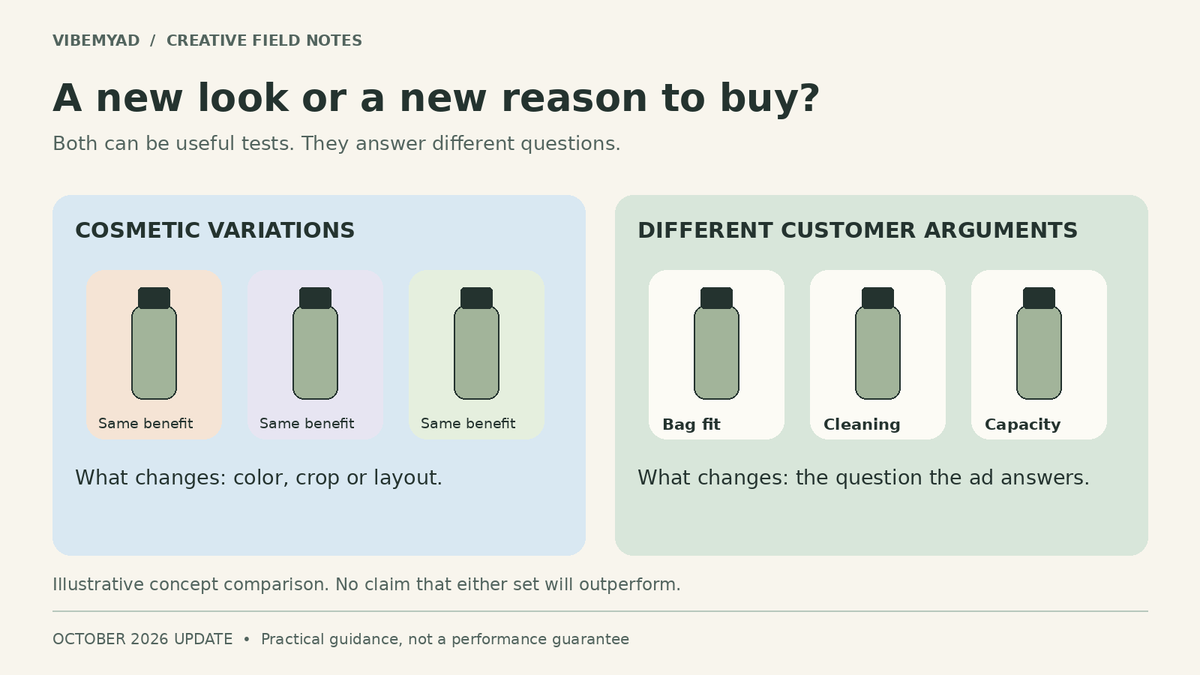
Original illustrative concepts. This comparison explains two types of test; it does not predict a winning creative.
Do not turn “creative diversity” into another production quota. Making twenty ads before deciding what you want to learn can consume the budget without answering a useful question. Nor does a different argument guarantee a different audience.
Take a reusable bottle. The following is an illustrative exercise, not a client campaign. Before using any angle, check that the product really supports it.
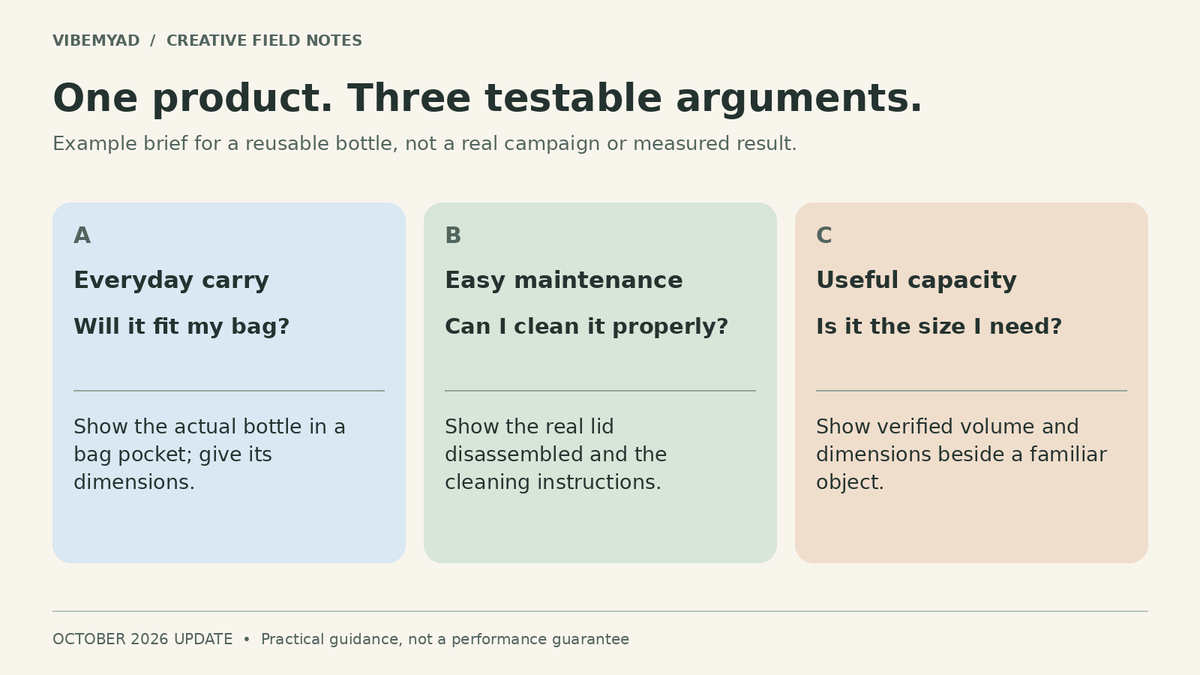
An illustrative brief for the same product. Use verified specifications and real demonstrations when producing the ads.
The shopper's question is: will this fit into my day? Show the actual bottle being placed into a commuter bag and give its dimensions. The opening could be “Will it fit your everyday bag?” The visual needs to answer that question, rather than merely show an attractive bottle.
Another shopper may care about cleaning. Show the real lid coming apart and explain the approved cleaning method. “See how the lid comes apart” makes a different promise from the bag demonstration. Do not claim dishwasher safety or hygiene benefits without evidence.
A third shopper may be comparing sizes. Show the verified volume and dimensions beside a familiar object. “Choose the size that suits your day” gives you a practical comparison to build. Avoid inventing how long one bottle will keep someone hydrated.
These briefs change the buying question, the demonstration and the information the customer gets. Our guide to Facebook ad hooks worth testing explains how to turn that question into an opening.
“Improve performance” is too vague for a brief. Is acquisition cost above your margin allowance? Are people clicking without purchasing? Are enquiries arriving from businesses you cannot serve? Write down the outcome that needs to change before commissioning the next batch.
List the argument, supporting proof and offer for each live creative. Then follow its link. If the ad promises a specific benefit but the page makes the shopper hunt for it, more ad variants may leave the same problem in place.
Start with ideas you can support and afford to test. The bottle exercise has three for clarity; it is not a required number per ad set. If your budget produces few purchases, splitting it across many simultaneous tests can make the evidence harder to read.
Record what each test changes, its objective and the decision you will make from the result. Avoid changing the offer, audience, page and concept together if your aim is to understand the creative's contribution. Use a controlled experiment where feasible. Our creative testing guide develops this process.
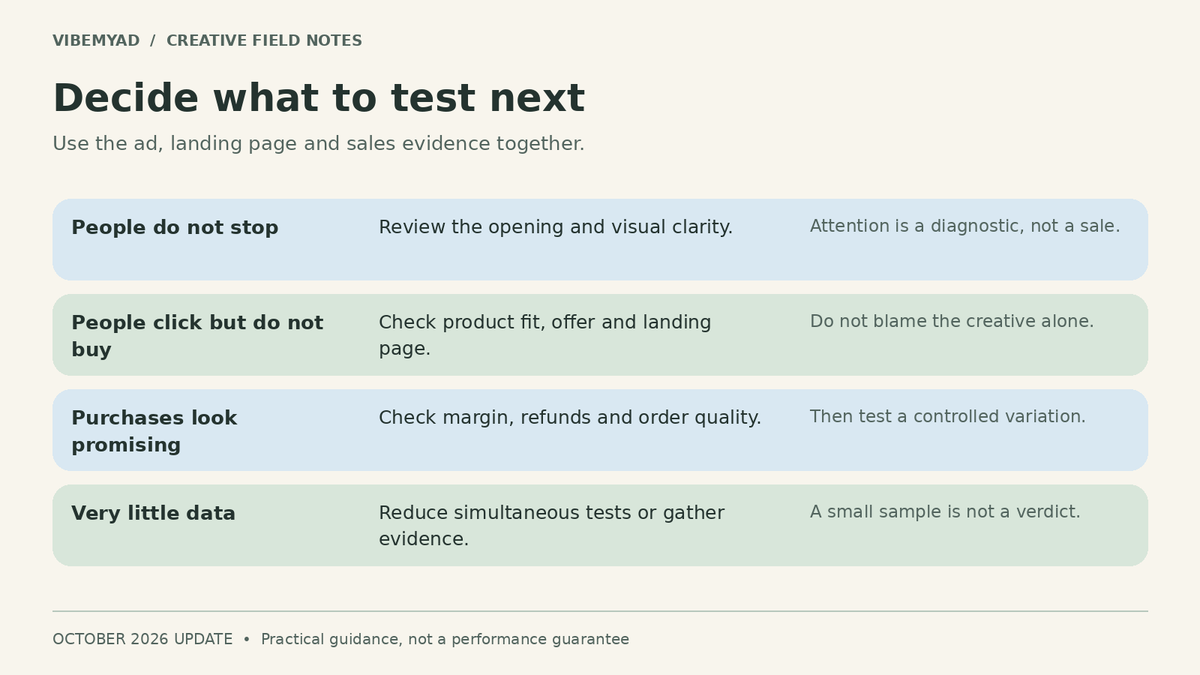
Use these as diagnostic prompts. A small sample or a change in reported conversions is not proof of creative impact.
For e-commerce, compare platform reporting with store orders, revenue, refunds and contribution margin over consistent periods. Attribution windows and purchase delays can produce differences. Backend revenue is a useful cross-check; it does not by itself prove which ad caused a sale.
For lead generation, separate a click, a form submission, a qualified enquiry and a booked call. An ad that produces cheaper forms may still be attracting the wrong buyers. Scale based on the outcome you actually need.
A small team does not need to respond to this announcement with an unlimited production schedule. It needs a repeatable way to move from a customer question to a credible demonstration, a test and a decision.
Competitor research can help you identify angles to investigate. An ad's long runtime or multiple variants is a clue, not access to its profit figures. Use our competitor ad analysis guide to turn observations into a brief rather than copying claims.
At Vibemyad, the agency conversation should start with the business problem and the product evidence you have. From there, we can help with creative research, production and testing. If you are deciding whether to outsource that work, read what a Meta ads agency does and when to hire one.
For a smaller first step, request five free ad angles for your product. Use them as hypotheses to review against your product facts and customer research. If you need help turning the selected ideas into finished ads, that is where our agency can take the work further.
Write the main buying argument of each current ad in one sentence. If the sentences are almost identical, you have a clear place to investigate. If they are already distinct, look at the proof, the offer and the customer journey before ordering more creative.
A new system announcement is a reason to understand the platform. Your own evidence should determine the next campaign decision.
Source and update note: Reviewed on November 5, 2026, against Meta's October 28 engineering announcement. Technical figures are Meta's claims. Creative recommendations and the bottle exercise are Vibemyad's editorial guidance, not official account settings or measured client results.


Ananya Namdev
Content Writer, Vibemyad


Rahul Mondal
Product, Design and Co-founder, Vibemyad

Rahul Mondal
Product, Design and Co-founder, Vibemyad
Table of Contents