September 30, 2026 • 7 min read

September 30, 2026 • 7 min read
Put three footwear ads beside each other and the differences become useful quickly. Allbirds gives you a trip to buy for. Vessi brings up a problem at work. Rothy's makes you want the shoes before explaining them.
That is where I would start a competitor ad analysis: what reason does each ad give someone to buy? A folder of attractive designs cannot answer that question on its own.
Below, we examine three actual static ads from the VMA archive, compare their arguments, and write a brief for a hypothetical footwear brand. You can use the same process for skincare, homeware or another D2C category.
These are archived references reviewed on October 5, 2026. Offers may have ended. We selected them for their contrasting creative choices, not verified campaign results; the archive does not give us their sales, spend or profitability.
For Facebook and Instagram, start with the Meta Ad Library. Select your market and the All ads category, search the advertiser, then confirm the Page belongs to the brand you intended to research. Our Meta and Instagram walkthrough covers the filters and advertiser checks in detail.
Choose a small set of brands that compete for a similar purchase. For this example, Allbirds, Vessi and Rothy's give us three different approaches to everyday footwear. Their customers and product ranges are not identical, which is useful to remember when comparing the messages.
Save the original creative, visible copy, source reference and the date you reviewed it. Open the destination page separately before drawing conclusions about the complete buying journey. The analysis below is limited to what appears in these three images.
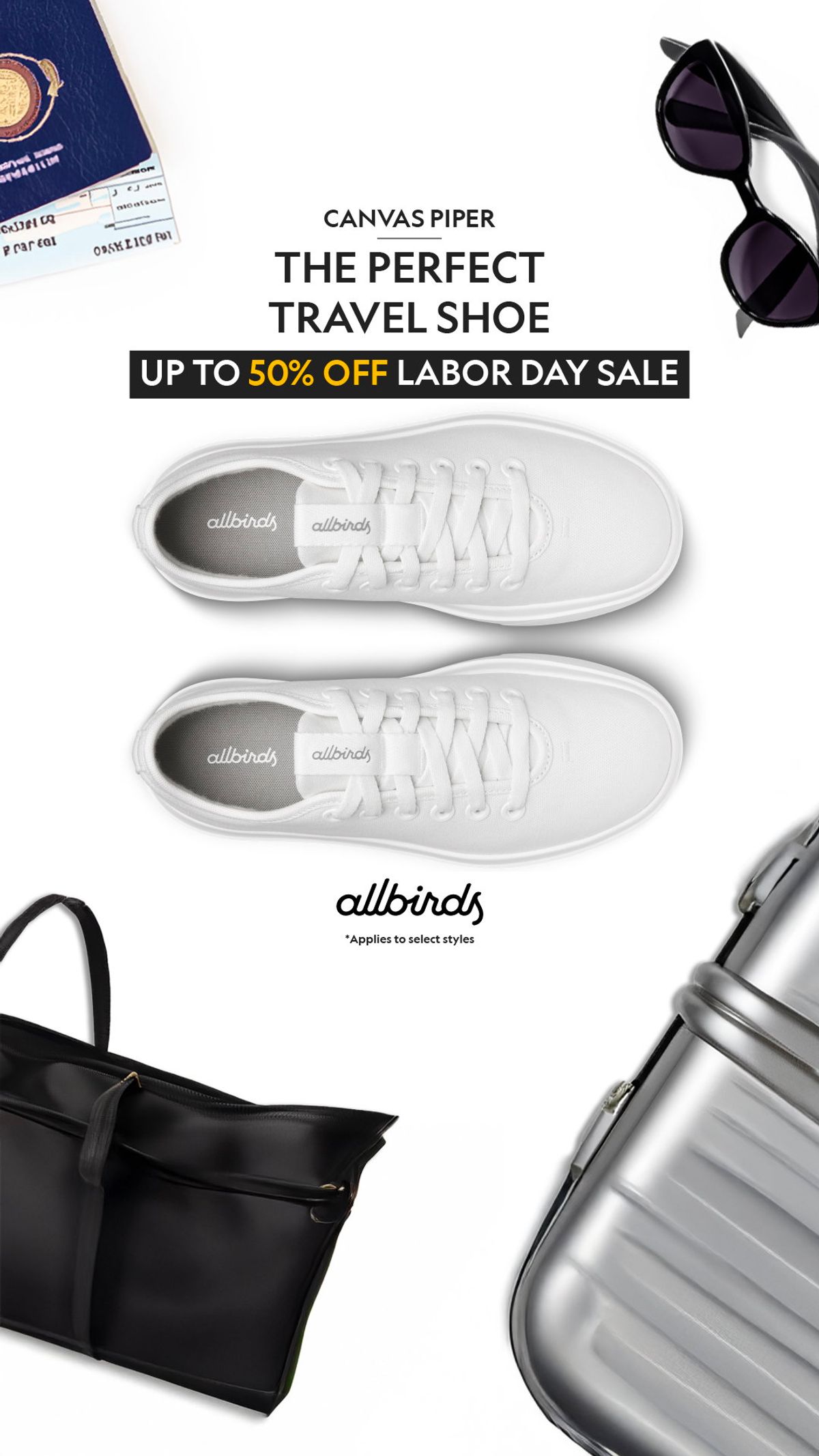
Allbirds, archived static ad. The travel props and seasonal offer create two separate reasons to buy. Source: VMA ad archive, img-9ce60b83ee0ae23d; reviewed October 5, 2026. Offer is historical.
The Allbirds ad puts white Canvas Piper shoes in the middle of a travel flat lay. A passport, sunglasses, bag and suitcase frame the product. The headline calls it "The perfect travel shoe," while a dark offer strip advertises a Labor Day discount of up to 50% on select styles.
The props do a specific job. Even with the headline covered, you could identify the occasion. That makes the image more useful than a shoe photographed against an arbitrary background.
There are two reasons to act here: an upcoming trip and a temporary price reduction. I would record those separately. If we copied both into a new test, we would struggle to tell whether shoppers responded to the travel idea or the discount.
The missing piece is a demonstration of why this shoe suits travel. The image establishes the setting, but it cannot show how the shoe feels after a long walk or how much space it takes in a bag. For a new brand with little recognition, I would test a visible product benefit alongside the travel setting before reaching for a large discount.
For your research sheet, the observation is simple: occasion-led product photography plus a sale. The production question is more interesting: what can our product show a traveler that a generic shoe photograph cannot?
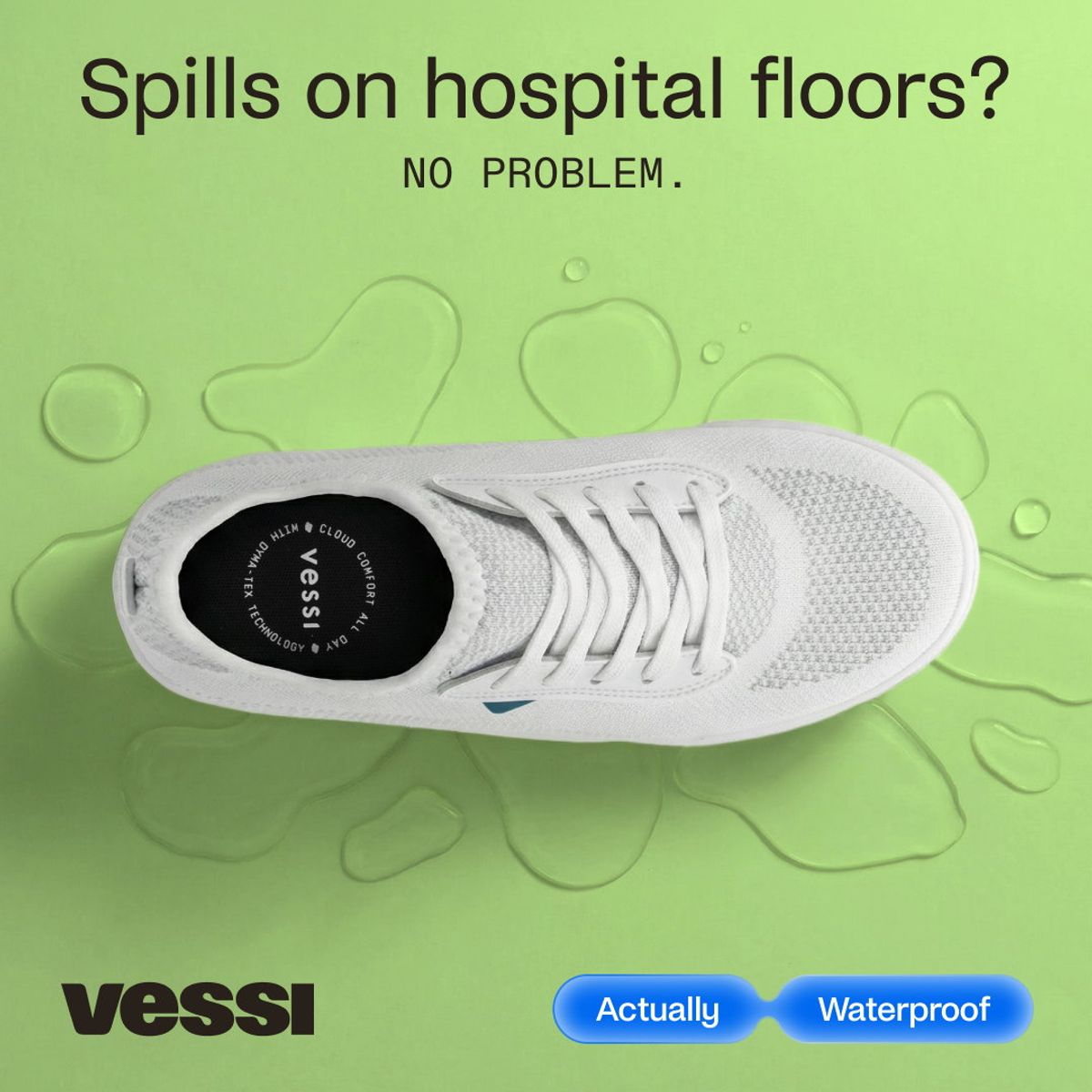
Vessi, archived static ad. The workplace named in the headline makes the waterproof claim specific. Source: VMA ad archive, img-bce147381ce7c398; reviewed October 5, 2026.
Vessi asks, "Spills on hospital floors?" A white sneaker sits over visible liquid on a bright green background. The bottom of the image carries the waterproof claim.
One location changes the meaning of the feature. Waterproof footwear could be advertised to almost anyone who encounters rain. Hospital floors point to a particular working environment and a particular annoyance. The copy gives the product photograph a reason to be there.
I would keep that specificity in the research notes. Writing "Vessi uses a problem-solution ad" loses the useful part. The stronger observation is that Vessi connects a feature to an identifiable moment in someone's working day.
The still image communicates the claim clearly, although it does not demonstrate the shoe keeping water out. A brand adapting this approach needs evidence for its own feature. It should also avoid adding claims the image never makes, such as slip resistance or suitability for every workplace.
For a footwear brief, I would ask the team to find one situation in customer reviews that deserves this level of detail. For a skincare brief, the equivalent might be a routine or application problem customers repeatedly describe. Start with their language before choosing the scene.
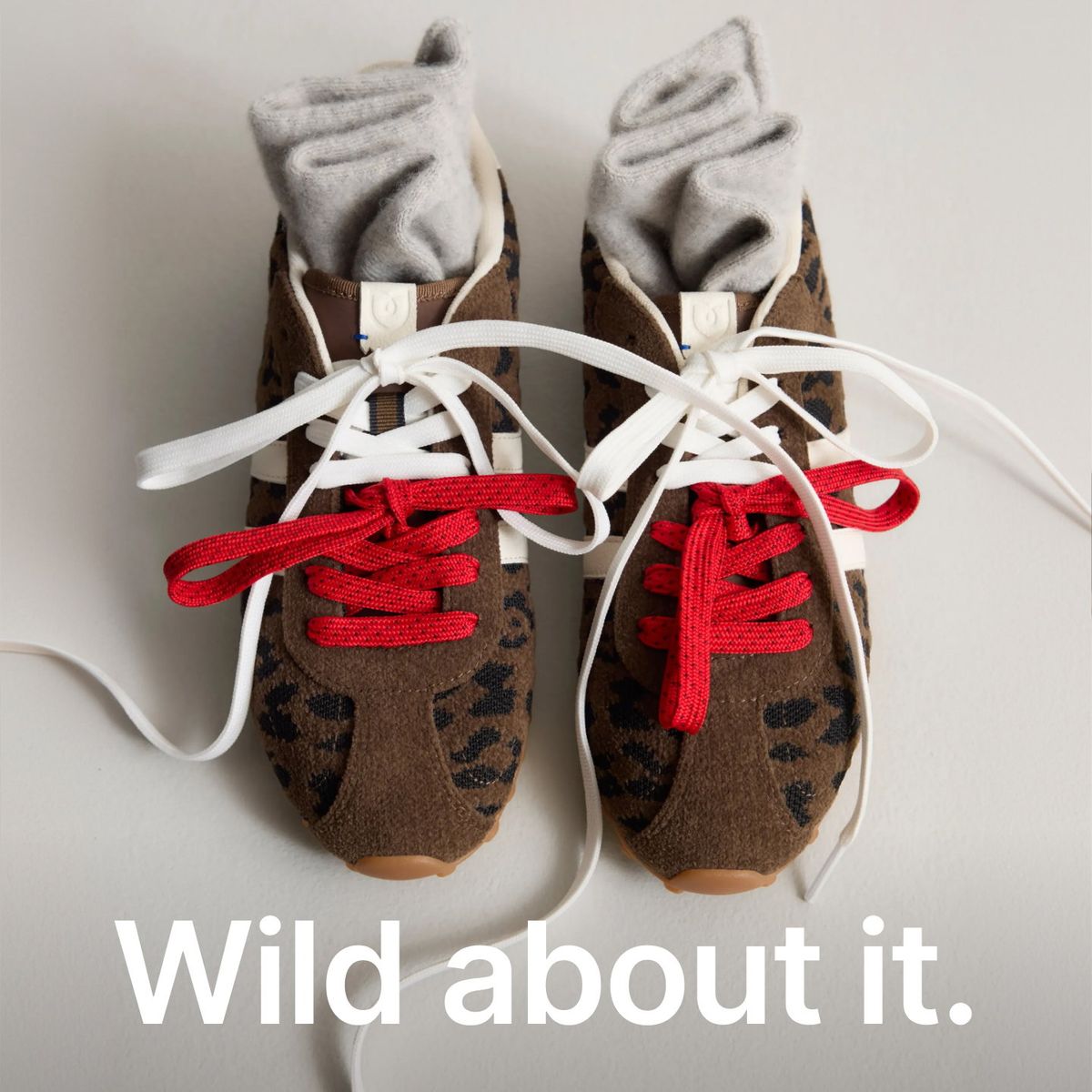
Rothy's, archived static ad. Product pattern and styling carry the message. Source: VMA ad archive, img-ac96d069dbc33287; reviewed October 5, 2026.
Rothy's takes a different route. Leopard-print sneakers, rolled gray socks and loose red and white laces fill the image. The short line "Wild about it" follows the product's pattern rather than introducing a separate argument.
Here, the photograph carries most of the message. You can see the print, texture and styling possibilities. There is no visible discount or long feature list competing with them.
I would save this as a reference for a product with a distinctive appearance. Its usefulness depends on having something worth looking at. Putting ordinary product photography under an equally short headline would not recreate the same effect.
This also changes the question we ask after the click. A shopper interested in the look will need to inspect colors, sizing and the product on a person. That is what I would check on the destination page; it is not something this archived image can answer.
For the next creative round, I would compare a styled product image with an image built around a specific use case. That tests two reasons to want the product, rather than two background colors.
Here is the completed comparison for these ads. The last column is our proposed next step, not a claim about what worked for the advertiser.
Notice what we have not established: that any of these is the best ad, or that a competitor spends more on one approach. For that separate question, our guide to evaluating competitor ads explains how to interpret public signals.
For a hypothetical brand selling a waterproof everyday sneaker, I would start with the commute. It gives us a specific occasion, a problem the feature can address and a scene we can photograph without an elaborate production.
That choice combines the usefulness of Allbirds' occasion and Vessi's problem framing. Rothy's adds a reminder to show how the shoe looks with an outfit. None of the three ads establishes whether our customers care about wet commutes, so customer evidence is the first requirement in the brief.
I would leave a discount out of this first comparison. We want to learn whether the situation makes the product relevant at its normal price. A promotion can be a separate test later.
This is an illustrative assignment for an invented brand, not a client case study. It assumes the brand can substantiate the waterproof claim and has customer feedback about commuting in wet weather. Without those inputs, we would choose another angle.
The designer now knows which scene to build. The copywriter knows the customer problem. The brand knows which facts it must supply. That is the standard I would use when reviewing the agency's research deliverable.
For more ways to build the scene, see our problem-solution ad examples. Use those references to discuss execution after agreeing on the customer question.
Compare the commute concept with a studio product concept using the same product, price and destination. Write down the budget, primary outcome and stopping conditions before launch. If you need a controlled comparison, use an appropriate A/B test rather than assuming ordinary ad delivery will divide spending evenly.
For a sales campaign, purchases and acquisition cost should inform the decision alongside order quality. Click response can help explain the result, but attractive clicks alone do not make the concept commercially useful. If one version receives too little delivery, the result remains inconclusive.
Our guide to planning a first creative test covers the next step. The competitor review should leave your team with a funded question to test and the materials needed to produce it.
Vibemyad Marketing Agency can research the category, write the brief and produce the ads. Bring the product, your customer questions and the campaign you want to improve. We can then agree on what the next round needs to prove.
Get notified when new insights, case studies, and trends go live — no clutter, just creativity.
Table of Contents


Rahul Mondal
Product, Design and Co-founder, Vibemyad

Rahul Mondal
Product, Design and Co-founder, Vibemyad


Arpita Mahato
Content Writer, Vibemyad