June 17, 2026 • 15 min read

June 17, 2026 • 15 min read
Your delivery platform is already deciding what your food looks like. The only question is whether you take that decision back, or let a stock photo of someone else's burger sell in your kitchen.
• Professional food photography costs roughly ₹15,000 to ₹80,000 per shoot (AUD $800 to $3,000, SGD $500 to $2,500, AED 1,500 to 6,000 elsewhere), disrupts your busiest hours, and has to be redone every time the menu changes, which is 4 to 6 times a year.
• Getting good AI food images is hard for seven specific reasons: structural cost, the 30-dish day, the 10 AM window, the plating gap, hidden food waste, platform control, and generic AI that redraws your dish.
• Generic AI tools are not the fix. Most change your actual food, with wrong colors, distorted shapes, and invented ingredients, so the output looks like AI, not your dish.
• Vibemyad Ad Gen generates accurate, on-brand AI food images grounded on your real dish, in one chat session at vibemyad.com/sessions, and exports at every Meta and delivery-platform spec. You run the campaign, it makes the creative.
• Vibemyad produces 100% hyper-realistic images. The food stays faithful to the plate that leaves your kitchen.
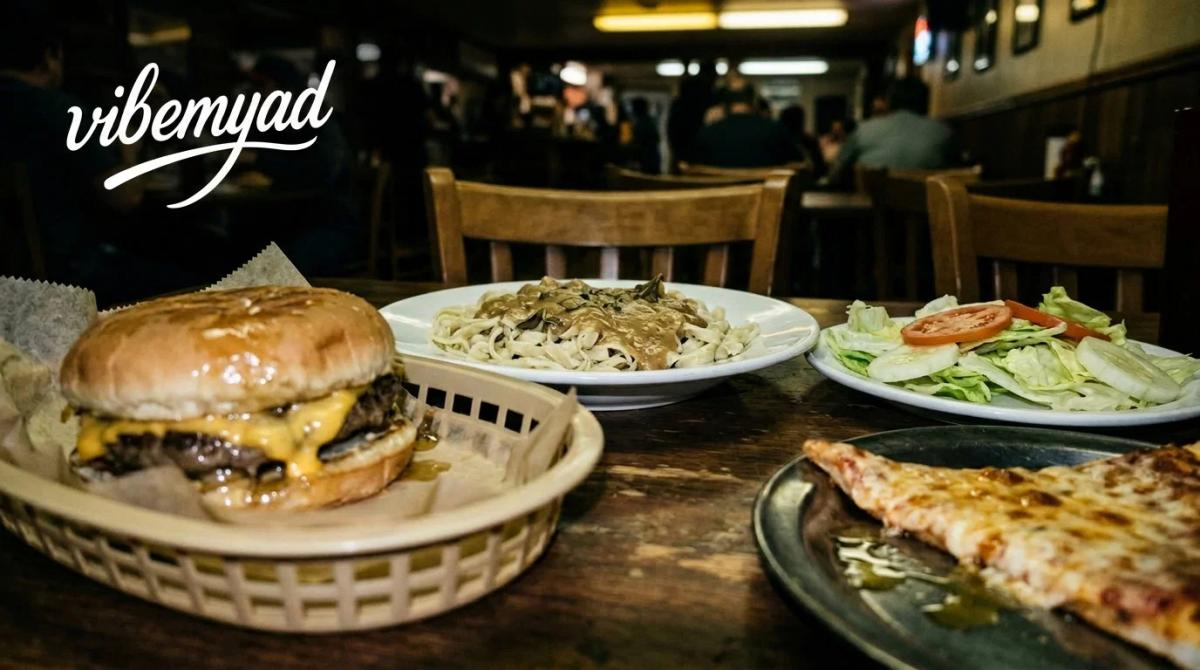
Independent restaurants do not let their food images go stale because they do not care. They let them slide because every path to good food images was built for a different restaurant, one with a stable menu, a marketing team, and a stylist on retainer. That restaurant is not you. There are seven reasons keeping images fresh is hard, and they stack on top of each other.
A professional food shoot, with a photographer, stylist, props, and lighting, runs roughly ₹15,000 to ₹80,000 in India, AUD $800 to $3,000 in Australia, SGD $500 to $2,500 in Singapore, and AED 1,500 to 6,000 in the UAE. For a national chain, that is a rounding error. For an independent restaurant on 3 to 9 percent margins, one shoot can cost more than the entire week's net profit.
And you do not get to do it once. Menus breathe. Diwali thalis, Onam sadyas, Ramadan iftars, Australian seasonal produce, Singapore hawker festival specials, the menu changes meaningfully 4 to 6 times a year, so you either keep paying or let the listing go stale. Most owners choose stale. That is not laziness; it is financial exhaustion.
So you try a generic AI image tool to escape the cost and the chaos. Type a prompt, get a picture. Then a new problem starts.
Most general-purpose generators do not preserve your dish; they redraw it. Ask for your signature double cheeseburger, and you get a burger with the wrong number of patties, a glossier bun than yours, cheese that melts in a way yours never does, and toppings you do not even serve. It looks like food, not your food. For a delivery customer deciding in seconds, that is the same betrayal as a misleading studio shot, just cheaper to produce. This is the failure that the rest of this blog addresses.
Every guide says shoot between 10 AM and 1 PM in natural light. Useless in practice. Walk into a working kitchen at 10:30 AM, and you will find stocks on the fire, deliveries arriving, and a sous chef at maximum stress. A calm photography window assumes you have a spare kitchen, a spare chef, and a spare hour. Most owners have none of the three.
The plate in your menu photo was styled by your head chef on a calm Tuesday morning. The plate goes out at 8:15 PM on a Saturday, assembled by whoever is free, under pressure, in 45 seconds. High staff attrition means the person trained on your standard may not even work there anymore. Your photo becomes a promise the kitchen cannot keep at scale, every service. The customer who ordered the photo and received the rushed plate does not blame the kitchen line; they blame you.
Cooking 30 full plates only to have them sit under hot lights and go straight in the bin is a real cost that never lands on the invoice. In higher-cost markets, waste adds AUD $300 to $800 or AED 500 to 2,000 in ingredients on a single shoot day. Nobody adds it to the shoot quote, so the true price of a photoshoot is always higher than the number you were given.
This is the one that should make every owner angry. Swiggy, Zomato, Deliveroo, Talabat, and foodpanda all tell you, correctly, that listings with images convert far better, so you have to have them. Then they enforce strict visual guidelines, roll out standardized AI photoshoots, or default your listing to generic stock photos that look nothing like your food.
You are trapped: you need images to survive, but the platform decides what they look like. A 30-year-old Udupi restaurant, a third-generation Singapore hawker stall, and a heritage Emirati eatery all get flattened into the same template that a product team decided looked clean. These platforms also take up to 30 percent commission, so you are paying them to distribute your food, meeting their visual standards, and losing your brand at once. That is not a pain point. It is a slow erasure.
Corporate chains shoot 3 hero items over 2 days with a dedicated stylist. An independent kitchen tries to shoot 30-plus items in one chaotic window to limit closure and labor cost. The comparison is not even fair.
Food has a 3 to 5 minute peak after plating before it starts dying visually. A kitchen line was built to send food out staggered by course, not to produce 30 plates at once for a camera. Cook too fast and dishes die on the staging table, cook too slow and the photographer stands idle on your dime. By dish twelve, everyone is tired, the lighting that made the beef curry look rich now blows out the white-sauce pasta, and the last 18 dishes get rushed. It shows in every frame.
The highest cost of bad food imagery is invisible: the orders you never get from a weak listing. According to restaurant-growth consultancy SpiceAdvisors, listings optimized with high-quality food images can see up to 40 percent higher impressions on delivery platforms, which makes image quality a revenue input, not an aesthetic one. The rest of the cost is just scattered; the shoot repeats 4 to 6 times a year, a 30-dish day burns ingredients into the bin, and post-production leaves 500-plus raw files to resize for every platform spec, so it never shows up on one line of one invoice.
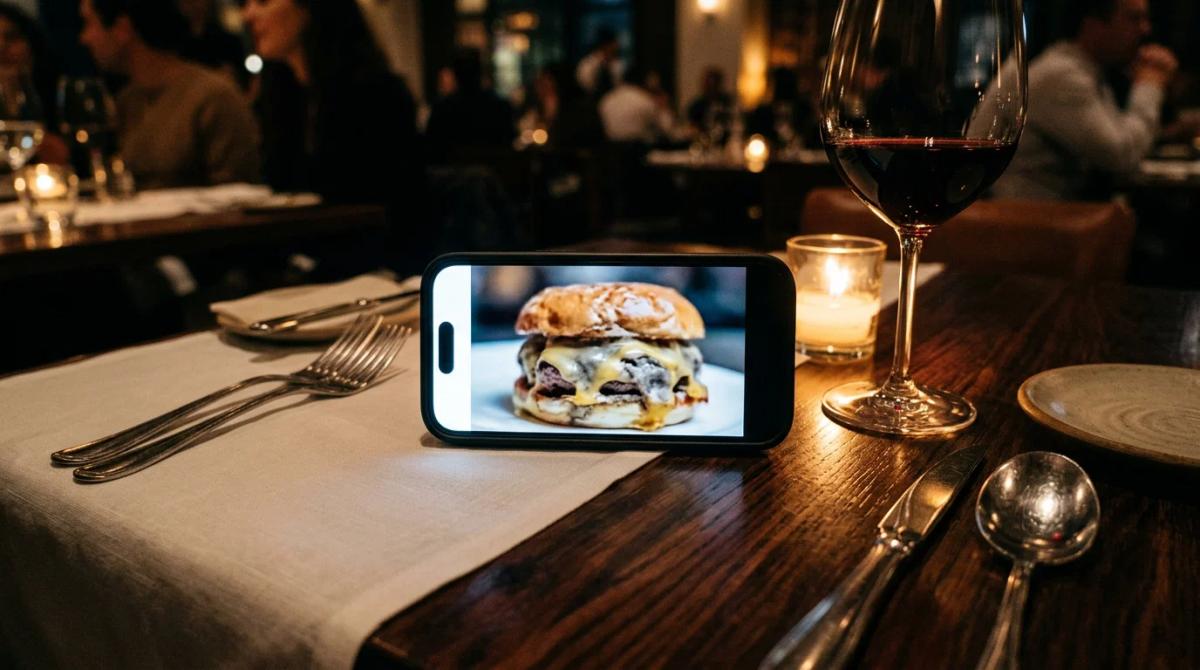
Pain point seven deserves a closer look, because it is the one most owners discover only after they have already given up on photoshoots. Three failure modes recur.
First, color and shape drift, because the AI generates a plausible burger, not yours, and for signature items, the exact char on the patty or the height of the stack is the dish. Second, low real variation: regenerate twenty times and get twenty versions of the same generic plate, none of them yours. Third, cultural collapse, since Western-skewed models render pani puri, medu vada, roti prata, and shawarma wrong in ways another prompt cannot fix.
The goal is not an AI image that looks impressive. It is an AI image that is still your dish. That distinction is the whole reason Vibemyad exists.
The fastest way to see the difference is side by side. Take one real dish, give the same brief to a general AI tool and to Vibemyad, and compare both against the actual plate.
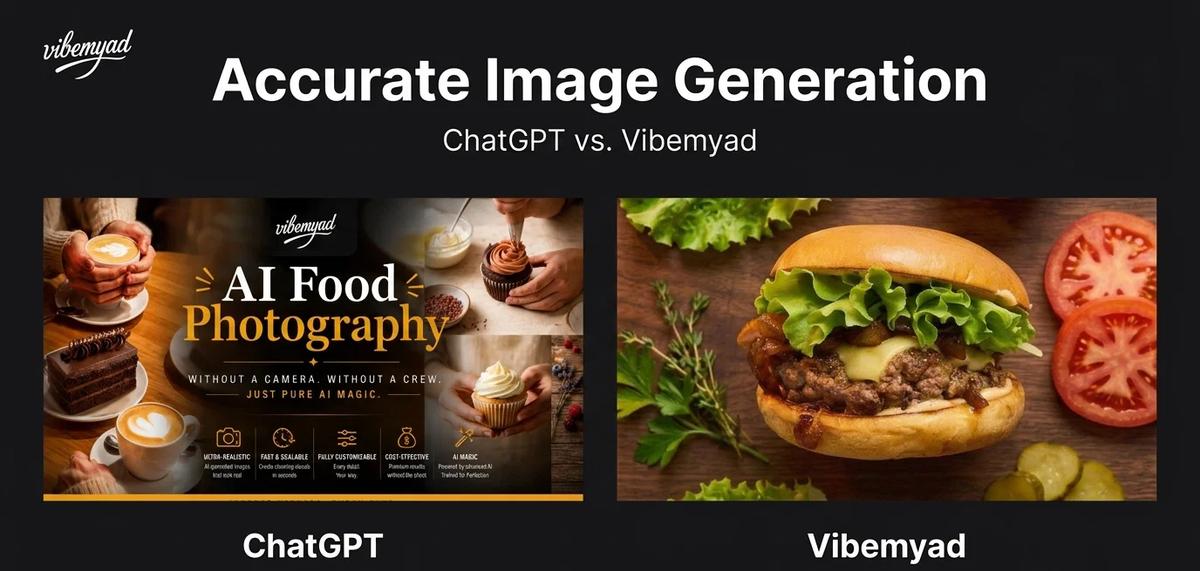
ChatGPT vs Vibemyad
The two tools are built on opposite assumptions about what a food image is for. The table below shows where that split actually bites.
Here is the reason behind the split. ChatGPT was built to generate a plausible image from a description, so accuracy to a specific real plate was never the point. It does not know your double cheeseburger; it knows what burgers tend to look like, and it renders the average. That is fine for a blog illustration and dangerous for a menu, because on Swiggy or Zomato, the photo is a promise. When the dish that arrives does not match the image that sold it, the customer does not blame the model; they blame you, and that broken trust costs you the reorder.
Vibemyad starts from the opposite end. It anchors on your actual dish, asks what it needs before it builds, and runs an Evaluator pass to check the output stayed faithful before you ever see it. The ChatGPT version looks like a competent stock image of a burger.
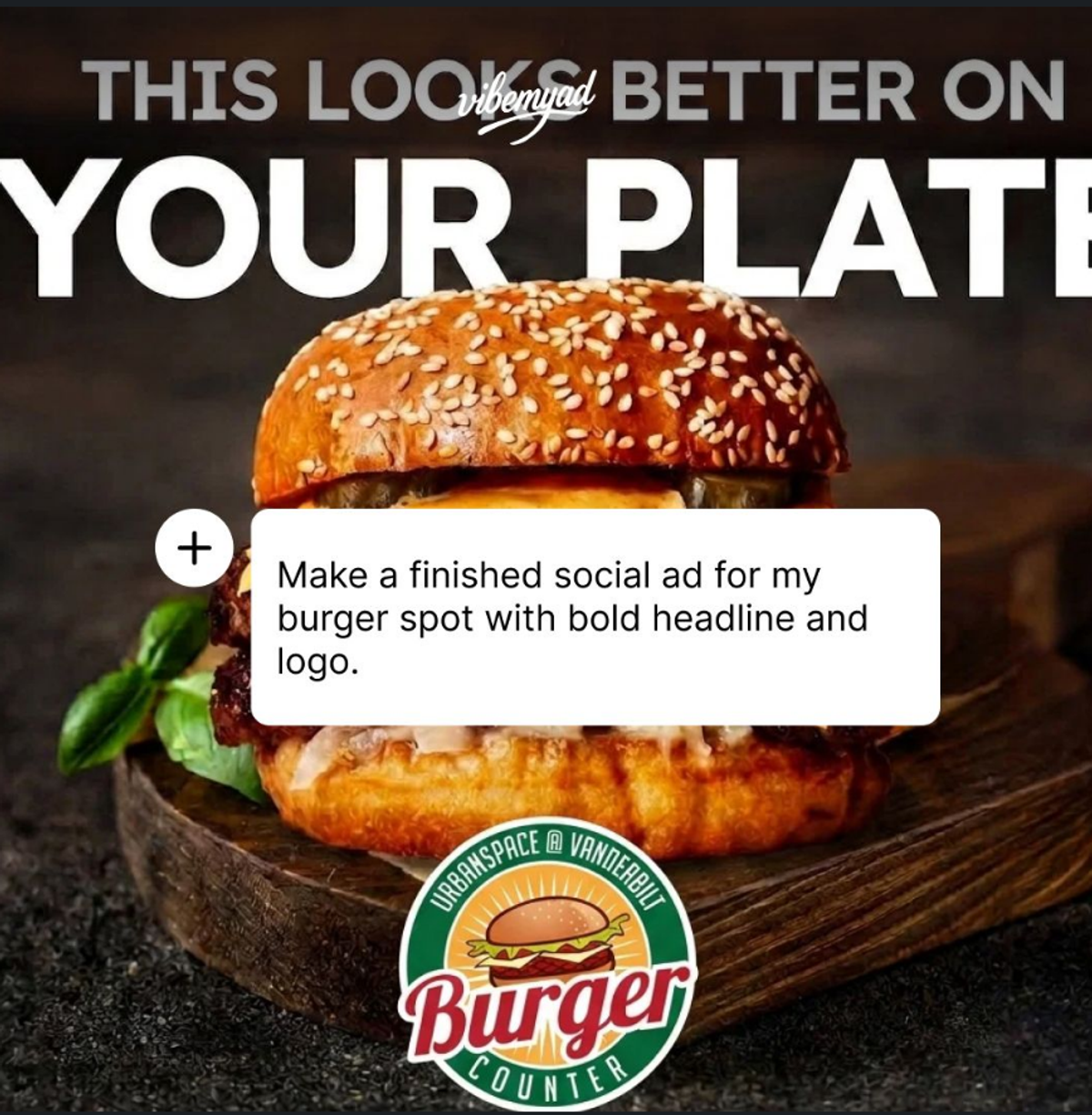
AI Generated Food Image
The Vibemyad version looks like the plate that leaves your kitchen, because it was generated from your real dish and audited to stay faithful to it. One sells a fantasy that the customer will not receive. The other sells what they will actually eat. On a platform where the photo sets the expectation, only one is safe to run.
You do not need a camera you do not own or a skill you do not have. A few choices decide whether your first generation lands, and they map directly to how Vibemyad uses your input.
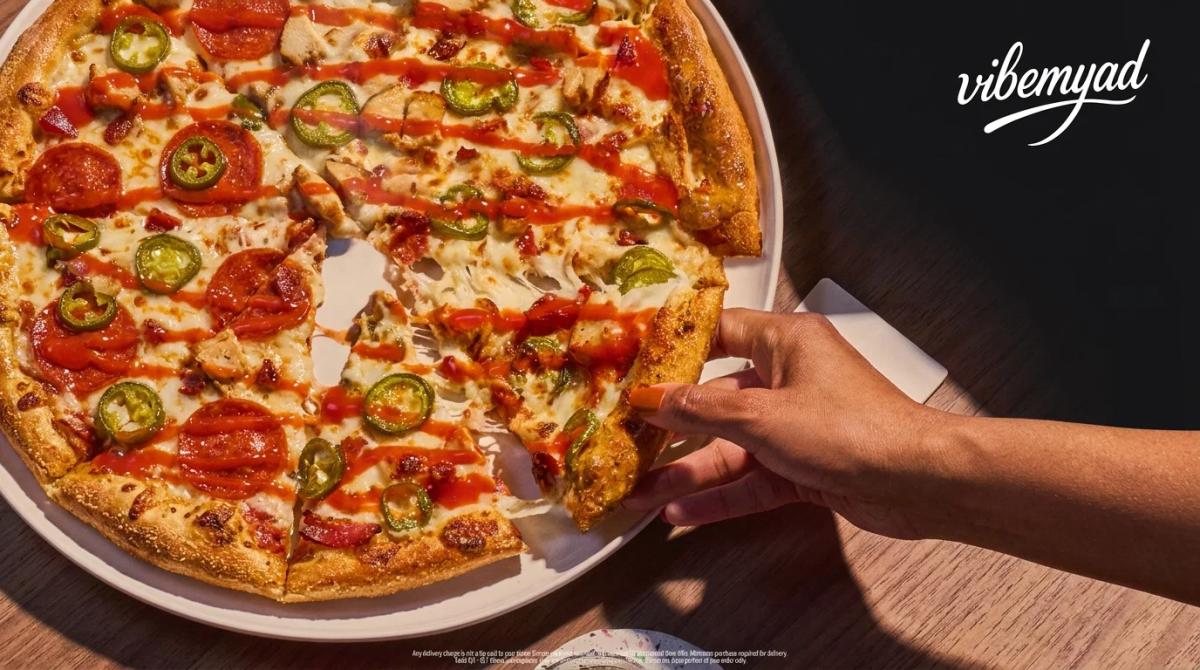
Food Photography
• Start with the cleanest real shot: Vibemyad keeps the real color, shape, and texture of the dish you give it, so your input sets the ceiling. A phone photo is fine. Soft window light beats hard flash, plate it fresh, keep the background quiet. Do not style it, the agent handles the scene. The dish just needs to be read clearly.
• Shoot the flattering angle, not the easy one: Flat dishes like a thali, pizza, or grain bowl read best overhead. Tall ones like a burger or layered dessert read best at 45 degrees, where the height shows. Unsure? Give the agent two or three angles and let it pick the cleanest.
• Match the preset to the job: Presets are ready-made looks, not filters. Flat Lay for menu spreads, Close-Up Detail for texture and scroll-stopping feed meta ads, To Scale for portion size, Outdoors and Styled Corner for venue feel. Pick the look that fits where the ad runs, then refine in plain language.
• Let accuracy lead the styling: Every tool tempts you to push the dish past what you serve. On a harmless feed. On a Swiggy or Zomato listing, it is the trap this blog is about, a promise the plate cannot keep. Make the real dish look like its best version, not a different one. The Evaluator pass holds that line, auditing each output for accuracy before you see it.
• Generate for the placement, not one square: Feed, Stories, grid, and delivery thumbnails all crop differently. Because the session holds context, remix the same dish into each format and keep it consistent across all of them. Plan for the set, not the single.
Vibemyad Ad Gen produces static restaurant food creative inside one chat session at vibemyad.com/sessions, ready at every Meta and delivery-platform spec. Start from a phone photo of your real dish or have the agent build the scene from scratch. Either way, the food stays accurate.
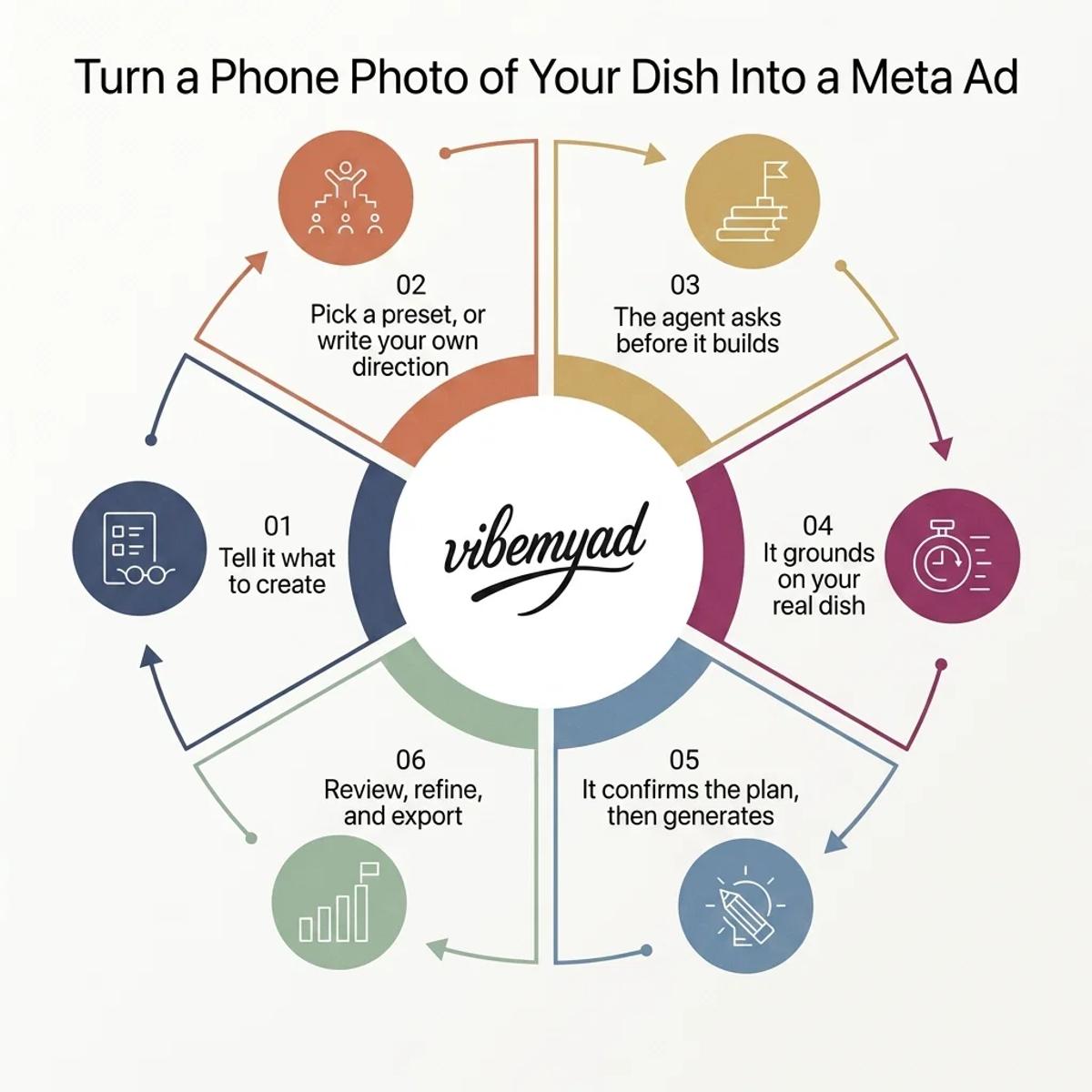
How to Turn Phone Photo into a Meta Ad
Step 1 · Tell it what to create: The session opens on "What would you like to create?", with tabs for Research, Images, and Videos. You type your request in plain language, for example, "an ad image of my double cheeseburger for a weekend delivery offer," and attach a phone photo if you have one.
Step 2 · Pick a preset, or write your own direction: Instead of a blank prompt, you can open the preset menu and choose a ready-made look the agent already knows how to make: Flat Lay, Close-Up Detail, To Scale, Outdoors, Styled Corner, and others. The preset guides the generation, so a good result does not depend on you knowing how to write a photography brief. You can still refine in plain language on top of any preset.
Step 3 · The agent asks before it builds: Rather than guessing, the agent asks a short set of tap-to-answer questions: whether you have a dish photo to feature as the hero or want the scene from scratch, the kind of venue, the type of dish. This step locks the brief with you before a single credit is spent, and it is the difference between a usable ad and twenty random regenerations.
Step 4 · It is based on your real dish: If you uploaded a photo, the agent works from it, keeping the real color, shape, and detail of your food intact rather than inventing a new dish. Give it several shots, and it picks the cleanest one to anchor on and tells you why. This grounding is why the output stays in your dish, not a generic look-alike.
Step 5 · It confirms the plan, then generates: The agent plays back the creative direction in plain language, the scene, mood, lighting, and what stays the hero, before rendering. You approve, the image generator runs, and the visual appears in the Generations panel beside the chat.
Step 6 · Review, refine, and export: Each generation lands in the Generations panel with its reference thumbnails and a step-by-step trail. Download it, or hit Remix to spin variations, a tighter crop, a different surface, a moodier vibe, without starting over. Because the session holds context, the same dish stays consistent across every variation, which is exactly what a carousel or full menu set needs. Export at the dimensions you need for Meta feed, Stories, Instagram, and delivery thumbnails.
Under the hood, that flow is several specialized agents working in sequence: a Creative Director and Router that interpret your brief, a Planner that asks the right questions and builds the plan, an Image Generator grounded on your reference, and an Evaluator that audits each output on four criteria: accuracy to your dish, brief adherence, structural integrity at ad scale, and brand consistency. You experience it as one conversation.
The proof of this holds at the hard end: a dessert brand selling cupcakes built a full Meta campaign in one Vibemyad session, hero shot, packaging mockups, and the same swirl of frosting on every cupcake across every frame, with no food stylist, no reshoots, and no drift between images. Frosting texture and color are exactly where generic AI invents its own version. If it holds for a cupcake swirl, it holds for your menu.
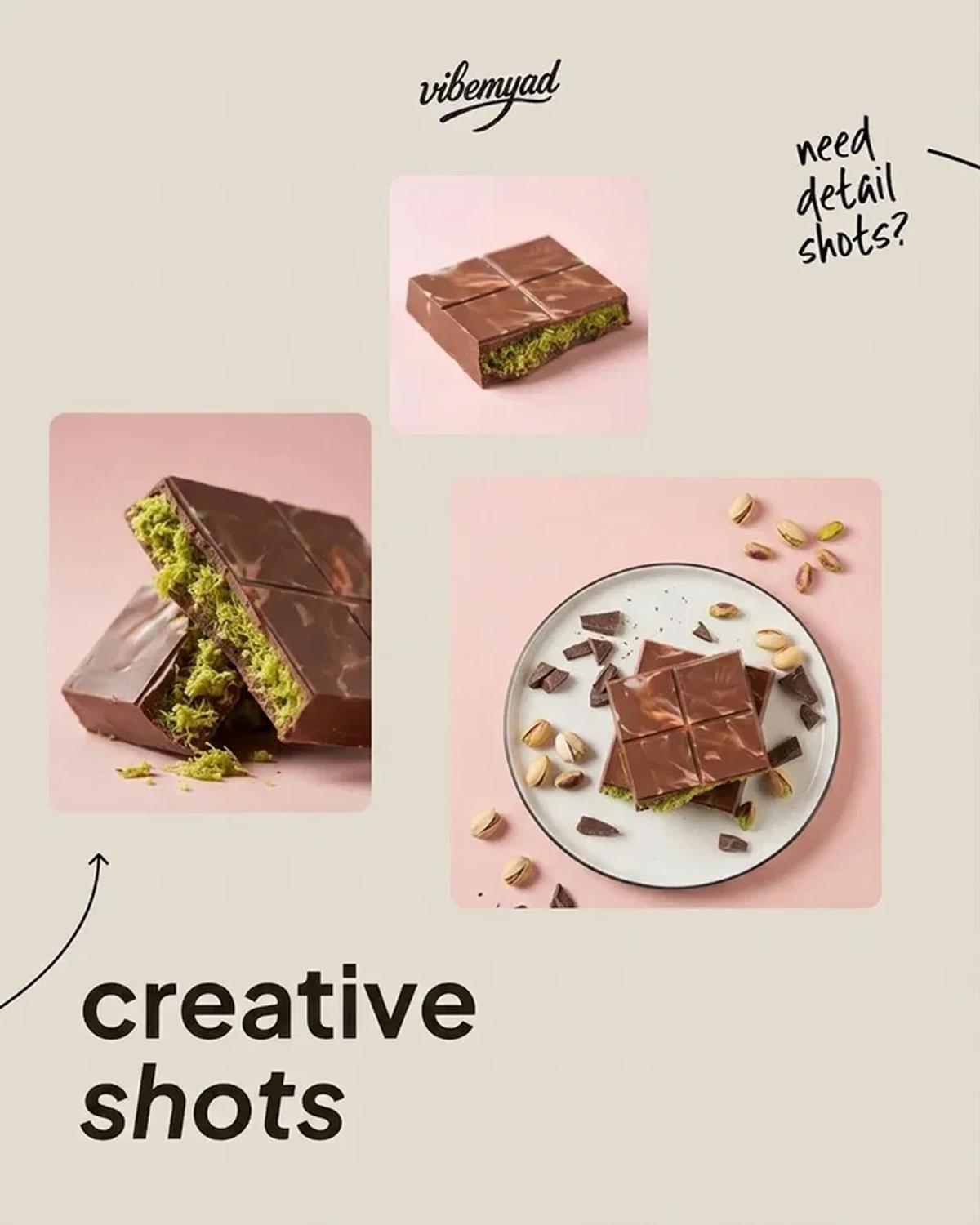
Generate Creative Shots with Vibemyad
The honest boundary: Vibemyad is an Agentic AI image generator. It does not set up your Pixel, build your lead form, choose your objective, or manage targeting and budget; those stay in your Ads Manager, and it does not generate video. What it removes is the hardest recurring input: enough accurate, on-brand food images to keep your ads and listings fed for months.
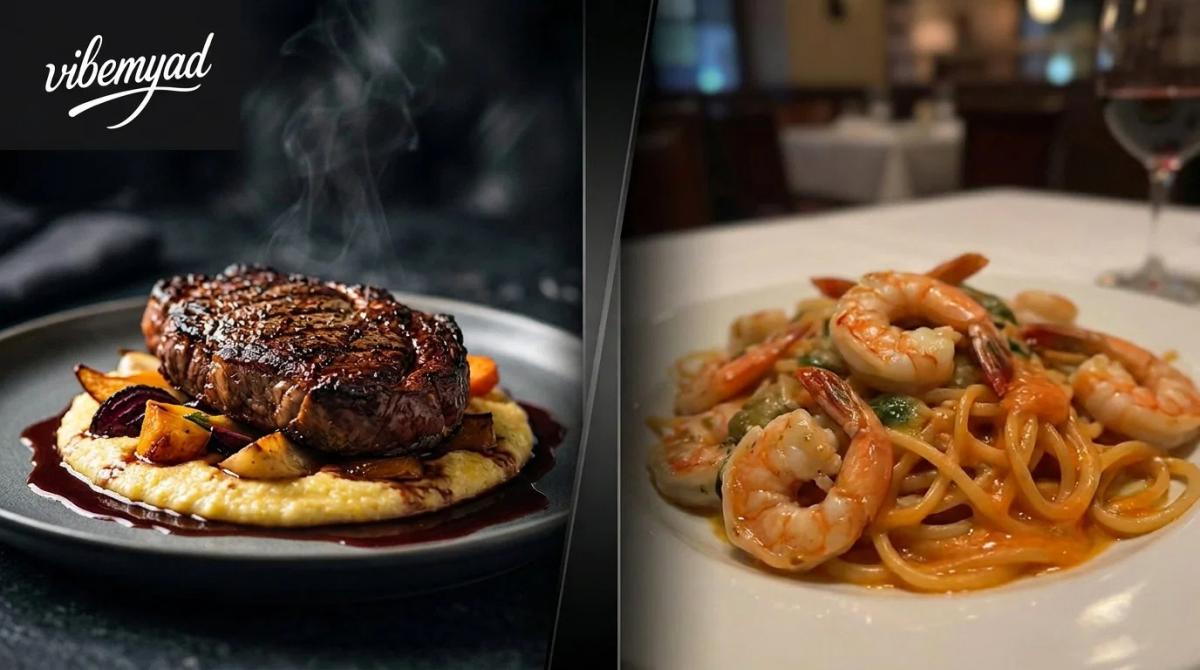
AI Generated Food Images for Restaurants
Across food and beverage, heavily styled studio shots often underperform against images that look like a real person took them at a real table. The reason is psychological: a glossy studio shot reads as an advertisement, while an image that looks like a friend's photo, warm light, a real plate, slight, honest imperfection, reads as a recommendation and earns the click.
This is why accurate AI food images suit independent restaurants so well. The aesthetic that converts is not the one that costs ₹80,000 to produce; it is the one that a good phone photo, kept true and cleanly composed, already delivers. Accuracy is not the boring choice here. It is the converting choice.
• Good food images are hard to get for seven stacked reasons, not one, and traditional photography solves none of them cleanly.
• The first six pain points are about cost, chaos, and control. The seventh, generic AI, looks like an escape but trades your real dish for a plausible fake.
• Vibemyad keeps the real dish intact by grounding generation on your photo and auditing every output for accuracy.
• The whole workflow happens in one chat session at vibemyad.com/sessions, with presets, clarifying questions, and Remix.
• Accurate, UGC-style food images are also the ones that convert best on Meta, so honesty and performance point the same way.
Cost, shoot-day chaos, platform control, generic AI that redraws your plate, every reason good food images stay out of reach comes down to tooling built for a restaurant that is not yours. You need none of it. You need your real dish kept accurate and turned into a creative that converts, in one Vibemyad session.
Get notified when new insights, case studies, and trends go live — no clutter, just creativity.
Table of Contents


Arpita Mahato
Content Writer, Vibemyad

Arpita Mahato
Content Writer, Vibemyad

Arpita Mahato
Content Writer, Vibemyad