June 11, 2026 • 13 min read

June 11, 2026 • 13 min read
You ran the ad. Good photo, decent copy, a few hundred people saw it. Maybe some likes. But the tables? Same as before. So you turned it off after two weeks and decided "Facebook ads don't work for us."
Here is the uncomfortable truth. Facebook works fine for restaurants. The format you chose did not. The brands consistently filling seats run two specific ad types most owners have never set up, and once they find the right offer and audience, they keep them running for months without rebuilding from scratch. This blog covers what those two formats are, why they outlast every other restaurant Facebook ad, and the part almost nobody talks about: the food photography inside the ad, and how to generate it yourself in one session instead of booking a shoot every time the menu changes.
A great photo, some copy about the special, a Book Now button. It works for a few days, then performance drops, cost per click climbs, you swap the photo, and the cycle repeats.
This is creative fatigue. When Facebook shows the same ad to the same audience repeatedly, engagement falls, and the algorithm charges you more to reach the same people. The penalty compounds because conversion campaigns are already expensive ones. One 2026 benchmark analysis found conversion-optimized campaigns run roughly $14.68 CPM against about $7.19 for reach campaigns, a 2x gap reflecting Meta's auction premium on higher-intent audiences. Fatigue stacks on an objective that costs double by design.
Here is the opinion most agencies will not say out loud: the boosted post is the single most wasted line item in restaurant marketing. It is the default because it is one tap from your phone, and that convenience is exactly why it loses, it optimizes for the cheapest behavior, likes and comments, not reservations. The single image ad has the same flaw in a better suit. Both are short-burn formats built for a spike, never for sustained acquisition. You are using a sprinting format for a marathon job, feeding it a single image that the audience exhausts in days. Two formats are designed to solve this, and most owners have touched neither.
Facebook's Lead Generation format lets someone submit their name, email, and phone number without leaving the app. The form pre-fills from their profile, so it takes about three taps. You offer something of immediate value and get a confirmed local contact in return. No website, no landing page, no mobile redirect bleeding off half your audience.
The engine is the offer mechanic. You are making a specific trade, a real incentive for their details, not asking someone to "come visit sometime." The data backs it hard: lead generation campaigns outperform traffic campaigns by 61% on click-through rate, averaging around 2.53%, driven by higher intent. People click because the offer is worth claiming, which does two things. It filters, since someone who fills a form for a free appetizer is far higher-intent than a website bouncer. And it captures the moment they think "I would actually go there," not a week later.
The offer does not need to be expensive. The most effective ones are the simplest:
• Casual dining: "Get a free dessert on your next visit. Claim your voucher below."
• Fine dining: "Join our priority guest list for first access to our seasonal tasting menu."
• Fast casual: "Sign up and get 20% off your first online order this week."
Specificity converts. "Stay updated on our specials" gets ignored.
The offer is only as strong as the photo selling it. The voucher converts because the image triggered a craving in the half-second before anyone read the words. A dull, beige, fluorescent-lit photo means the best offer in your market still scrolls past. You need a scroll-stopping hero image, refreshed every several weeks as the offer changes, and booking a photographer for every seasonal swap is not realistic for a single location. The fix is generating it yourself from a photo of your real dish, the workflow below, and the full subject of our blog on AI food photography without a photographer.
The form alone is just data collection. What turns it into revenue is the follow-up: the moment someone submits, trigger automated delivery of their voucher within minutes via Mailchimp, Klaviyo, or a Zapier text with a unique code. The faster the follow-up, the higher the redemption, and now you track true cost per acquired customer, not just cost per click.
A food photo goes stale. A well-structured offer does not. Every six to eight weeks, nudge the incentive to match the season while structure and targeting stay the same, a twenty-minute update when you can generate the visual on demand. The list compounds too: upload it as a Custom Audience to retarget non-visitors, and build a Lookalike Audience so Meta finds new locals matching your best leads, cheaper every month.
A carousel shows five to eight cards in one ad unit, each with its own image, headline, and link. Over the first few days, Meta tests which cards earn the most engagement, promotes the strongest to the front, and dials down the weak ones, so the audience always sees the most compelling version rather than the same card every time. Fatigue is delayed significantly versus a static image, which goes stale the second time someone sees it.
For a restaurant, this is powerful because you are selling an experience, not one thing: food variety, atmosphere, value, occasion, each card a different reason to choose you. And the visual ceiling is real. Food is one of the few verticals that consistently clears the 2% CTR benchmark on Facebook, because the imagery itself triggers immediate appeal. A carousel gives you five to eight chances to land that craving, but only if every card is actually appetizing.
Here is the catch nobody warns you about, and the real reason restaurants quietly abandon the better format. A single image ad needs one good photo. A carousel needs five to eight, all consistent, on-brand, and appetizing enough to earn a swipe. Most restaurants do not have eight studio-quality shots, and producing them is a full photographer's day that the budget lacks, so the carousel never gets built, and the owner defaults back to the boosted post that does not work. The format does not fail them. The image supply does.
Generating the full set in one place removes that wall, grounded on your real dishes and held to one look across every card, the same consistency that matters across all your Meta ad creative, and the same reason delivery and menu imagery benefit from a single source of truth in our AI product photography workflow.
Each card has a job:
• Card 1: Hero dish or strongest visual with a hook in the headline. Your scroll-stopper.
• Cards 2 to 4: Variety cards, different menu categories, a signature drink, an atmosphere shot.
• Card 5: Social proof, "Rated 4.8 stars by 1,200+ guests" or a short customer quote.
• Card 6: Seasonal special or limited-time offer for urgency.
• Final card: Direct CTA, "Reserve your table" or "Order online tonight," linked to your booking or ordering page.
Link every card to its relevant destination, not your homepage. Every extra step between swipe and booking loses people.
The costliest mistake is running the carousel under Traffic or Engagement because it looks cheaper. Traffic finds clickers, Engagement finds likers, neither finds people who book a table. Run it under the Sales objective with the Meta Pixel installed and a Purchase or Lead event configured, or the algorithm has no signal to optimize toward. Meta needs roughly 50 conversion events to exit the learning phase; another reason these campaigns run for months, not days.
To refresh, you do not rebuild. Every six to eight weeks, swap in new cards, keep your top performers (Ads Manager tells you which), and replace only the low-engagement ones. Because the structure holds and only weak cards change, the recurring work is purely creative, the part you can generate on demand instead of reshoot.
The two formats that last both depend on the same input; the short-burn formats do not: a steady supply of strong, on-brand food images. That is the part you can generate yourself, and here is how.
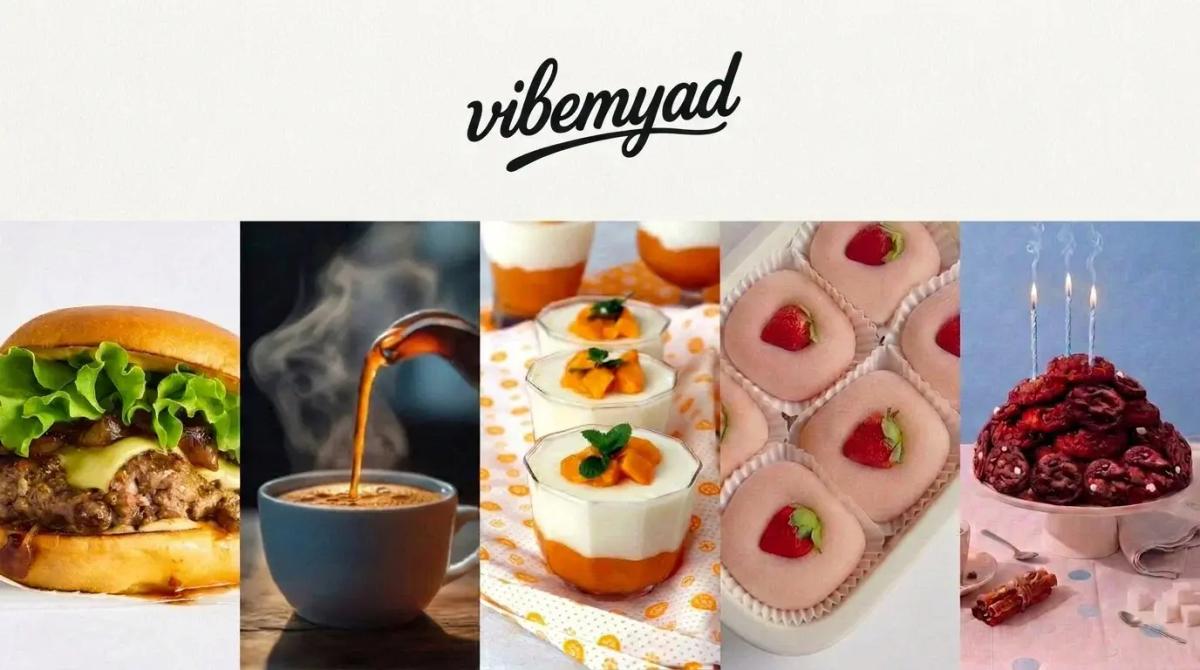
Generate Food Images using Vibemyad
Both formats run on one input: believable, appetizing food images, refreshed often. Vibemyad Ad Gen generates static restaurant food creative from a photo of your real dish, in one session at vibemyad.com/sessions, ready at every Meta placement spec.
• Step 1: Brief the agent: At vibemyad.com/sessions, name the dish and ingredients, the format you need (a lead gen hero, or a carousel set), the brand reference, and any specificity like regional cuisine or a seasonal occasion. A brief that works: "Carousel set for weekend brunch. Hero shot of the pancake stack, plus variety cards for the avocado toast, the cold brew, and a table-spread atmosphere shot. Warm, bright, weekend mood. 1:1 and 4:5. Brand book attached."
• Step 2: Research Mode: The agent identifies which creative patterns are converting for restaurants in your category and price tier right now, and surfaces the visual cues high-performing food ads share. The Router agent decides whether your brief needs this research pass or direct execution. It takes seconds.
• Step 3: Creative direction: The Creative Director agent returns a recommended direction, composition, lighting, mood, color palette, visual style, plus the references it drew on. You approve, refine conversationally ("warmer light, fewer props, closer on the pancakes"), or redirect.
• Step 4: Plan the changes: The Planner agent lays out every change inside the conversation before any pixels render: background, subject placement, lighting, props, color grading, garnish. You approve or adjust each before it executes, which prevents the regenerate-twenty-times problem that defines prompt-shot tools.
• Step 5: Generate and audit: The Image Generator produces each visual, then the Evaluator agent audits every output against four checks: accuracy (it is your actual dish), prompt adherence (matches the brief), structural integrity (no warped plates or broken hands at ad scale), and brand consistency across every card. Only outputs clearing all four advances. Failures route back to the Planner.
• Step 6: Edit Mode and export: Refine in the same conversation, moving the dish, warming the lighting, and changing the vessel. The agent holds character state, so the same plate, hand model, and product persist across every card, exactly what carousel consistency demands. Export at 1:1, 4:5, 9:16, or 1.91:1 for every placement.
The proof of this holds at the hard end: a regional Indian D2C brand selling pani puri built a full Meta campaign in one Vibemyad session, hero shot, packaging mockups, detail angles, and the same hand model across every lifestyle frame, no food stylist, no reshoots, no character drift. Culturally specific cuisines are where generic AI tools collapse because their training data skews Western. Vibemyad handles them because the agent is grounded on a real reference and your real product. If it holds for pani puri, it holds for your menu.
The honest boundary: Vibemyad is an image only. It generates the static creative that these formats run on. It does not set up your Pixel, build your lead form, choose your objective, or manage targeting and budget; those stay in your Ads Manager, and it does not generate video. What it removes is the hardest recurring input in the system: enough strong, on-brand food images to keep both formats fed for months.
Run together, lead gen and carousel create a compounding loop, not two campaigns side by side.
• The carousel sits at the top, running to a cold local audience within three to five miles, building craving over multiple impressions. Pasta on Monday, cocktail on Wednesday, brunch on Friday. They are warming up.
• The lead gen ad closes, reaching them through retargeting or a Lookalike Audience built from your customer list. The specific offer catches them at the right moment. Three taps, voucher, booking.
• The loop compounds. After they visit, they enter your Customer List, which feeds a new Lookalike Audience for the carousel, now targeting people who look like your actual paying customers. Each cycle gets more efficient: reach improves, cost per lead drops.
The one input this loop consumes continuously is fresh creative. Every refresh and every new offer needs new images, and the loop stalls the moment that depends on photographer availability. On budget: roughly 40% of weekly spend to the carousel, 60% to lead gen and retargeting. For most single locations, $150 to $250 weekly is enough for meaningful data and real bookings inside the first month.
• Mistake 1: A weak offer paired with a weak image. "Sign up to hear about our specials" is a newsletter subscription, not an offer. It needs to be specific, immediately valuable, and exclusive, with a hero photo that makes it look worth claiming. "Free starter on your next visit, no minimum spend, valid this month" over an appetizing image is an offer. "Stay connected with us" over a dim phone snap is not.
• Mistake 2: The wrong objective. Traffic finds cheap behavior, clicks without buying. To fill tables, you need the Sales objective and the Pixel firing correctly. It costs slightly more per click and significantly less per reservation. If your Pixel is not set up, fix that before spending another dollar on conversion campaigns.
• Mistake 3: Killing it during the learning phase. Meta needs around 50 conversion events to exit learning. Spending $20 a day, getting one or two leads, and quitting after five days means you never gave the algorithm enough data. Give every campaign 10 to 14 days minimum, and judge it on cost per lead, not day-three impressions.
The one thing that quietly decides whether either performs is the food photography filling it, the lead gen hero, the carousel cards, and the seasonal refresh every six weeks. That is the part you can stop outsourcing.
Get notified when new insights, case studies, and trends go live — no clutter, just creativity.
Table of Contents


Arpita Mahato
Content Writer, Vibemyad

Arpita Mahato
Content Writer, Vibemyad

Arpita Mahato
Content Writer, Vibemyad