October 01, 2026 • 5 min read

October 01, 2026 • 5 min read
A competitor can keep an advertisement live for months and still lose money on every order. Another can replace an advertisement after ten days because it taught the team exactly what to build next. Public longevity is useful evidence, but it is not a profit report.
That distinction is the foundation of competitor ads analysis. You are not trying to declare winners from the outside. You are ranking observable signals, forming hypotheses, and deciding which ideas deserve a controlled test in your own account.
Before interpreting performance signals, confirm that you are collecting the right evidence. This guide explains how to see competitor ads on Meta and Instagram using public sources.
Usually, no. Meta’s public tools can show the advertiser, visible campaign execution, start date, listed platforms, copy, call to action, and landing-page destination. They do not reveal customer acquisition cost, conversion rate, contribution margin, refund rate, audience quality, or incremental revenue.
That means a long-running advertisement should be treated as a clue, not a verdict. An advertiser may keep it active because it works, because it supports another channel, because the budget is small, or because nobody has reviewed it recently.
This caution is supported by research. A study examining 663 Facebook experiments found that common observational approaches could not reliably reproduce experimental estimates of advertising effects.
Use several signals together. One clue is weak. A consistent pattern is more useful.
Longevity becomes more meaningful when it appears beside repeated messaging, thoughtful variations, and landing-page continuity. Our analysis of 10,000 D2C ads on Meta shows how recurring structures appear across long-running campaigns.
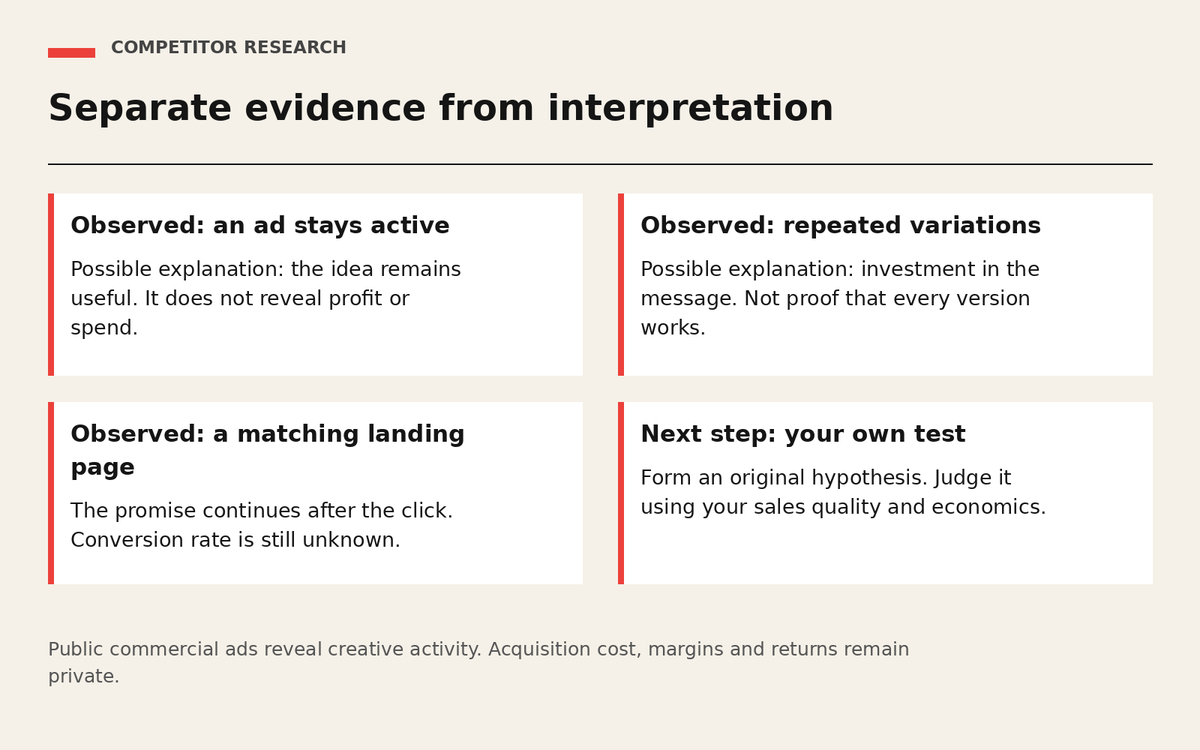
Separate what you can observe from what you still need to test.
Apply the same caution to your own campaigns. Learn how long to run Meta ads before judging them before treating early volatility as a final result.
A review of indexed advertising activity inside Vibemyad shows three useful patterns. WHOOP uses several buying contexts, including recovery, new parenthood, and HSA or FSA eligibility. The lesson is not to copy a WHOOP advertisement. It is to notice how one product can be framed around different moments of relevance.
Kitsch repeatedly returns to a clear commercial argument for its thermal brush, while changing the surrounding execution and promotion. Liquid I.V. distributes related messages across Facebook, Instagram, WhatsApp, and Threads. In both cases, repetition around a business idea matters more than any single thumbnail.
These examples suggest commitment, not guaranteed performance. The practical question is whether the repeated message exposes an important customer problem, proof point, use case, or offer that your category also needs to address.
Score each campaign family rather than each isolated advertisement. Give one point for every condition you can verify:
1. The advertisement has meaningful longevity.
2. Several executions repeat the same central message.
3. The idea appears in more than one format or placement.
4. The landing page continues the promise.
5. The offer, proof, and audience context are commercially coherent.
A score of four or five makes the campaign worth studying. It still does not make the advertisement a winner. Record the evidence and your confidence level so the team can separate facts from interpretations.
High engagement is the most seductive false signal. Comments may reflect controversy, existing fans, customer-service complaints, or an entertaining video that attracts people who will never buy.
A large number of active advertisements can also mislead. Meta may group variations, markets, placements, and duplicated campaigns. Volume shows activity, not efficiency. Brand familiarity creates another distortion because a famous company can make an ordinary execution look powerful.
Finally, do not confuse similarity with validation. If every competitor uses the same claim, the market may value it. The category may also have become visually and verbally interchangeable.
Start with the pattern, then move one level deeper. Ask what customer belief the competitor is trying to change. Turn that belief into an original hypothesis supported by your own product evidence.
For example, if several brands repeatedly demonstrate speed, do not recreate their demonstrations. Test whether speed is the deciding customer concern, then prove your version through a different situation, spokesperson, comparison, or product moment.
Build three materially different executions around the hypothesis. Keep the audience, offer, and landing-page path sufficiently controlled. Judge the result using qualified sales, acquisition cost, contribution margin, and purchase quality, not reactions alone.
For a practical framework, see how to use competitor ad data to improve your campaigns.
A useful review should force four answers: What did we directly observe? What are we inferring? What evidence can our brand supply? What result would prove the hypothesis wrong?
If the team cannot separate those four answers, competitor intelligence has become mood boarding. Public activity reveals patterns, but effectiveness still depends on customer context, proof, and economics. These are among the characteristics explored in What Makes an Effective Ad? Look at Ads That Last.
If you are still building your research set, start with What Ads Are My Competitors Running? How to Find Out.
Vibemyad Marketing Agency turns public competitor activity into evidence-ranked campaign hypotheses. We identify repeated messages, gaps, offers, and proof patterns, then show your team what deserves a test.
Get notified when new insights, case studies, and trends go live — no clutter, just creativity.
Table of Contents


Rahul Mondal
Product, Design and Co-founder, Vibemyad

Rahul Mondal
Product, Design and Co-founder, Vibemyad


Arpita Mahato
Content Writer, Vibemyad