August 19, 2026 • 10 min read
An ecommerce marketing agency helps an online store acquire customers, convert more of the traffic it already has, and increase the value of those customers over time. Depending on the engagement, that can include paid media, creative production, SEO, email and retention, conversion work, measurement, and growth strategy.
• An ecommerce marketing agency works on demand and growth around the store. A development agency is primarily responsible for building, migrating, or engineering the store itself.
• Common service areas include strategy, creative, paid media, SEO/content, lifecycle/email, measurement, and conversion optimization. The right scope depends on the store's actual constraint.
• Pricing can be a retainer, percentage of spend, project fee, hybrid, or outcome-based model. Compare the scope and incentives before comparing the headline fee.
An ecommerce marketing agency is a team hired to grow an online store through some combination of acquisition, creative, search, retention, conversion, and measurement. It may work closely with developers, but ongoing marketing and store engineering are different jobs.
The label covers several operating models, so the useful question is not simply whether a firm calls itself an ecommerce agency. It is which parts of growth it actually owns.
• Full-service or integrated agency. Several disciplines under one engagement, with one team responsible for coordinating them.
• Channel specialist. Deep expertise in one area such as Meta, Google, SEO, email, or creative production.
• Freelancer or fractional specialist. A senior operator who owns a narrower scope, often with lower overhead and less cross-functional capacity.
Brands often move between these models as their needs change. The right choice depends on whether the problem is narrow enough for one specialist or requires several functions to work together.
These two categories often overlap in sales language, but the work and success criteria are different.
The short test: if the store itself needs to be built, migrated, or engineered, start with development. If the store works but growth is the problem, marketing is the more relevant category. If paid acquisition and creative are the immediate bottleneck, see Vibemyad's Meta ads agency service.
The table below covers common service areas. A full-service agency may own several of them; a specialist may intentionally own only one or two.
Search is also changing. Traditional SEO still matters for rankings and qualified organic demand, while AI-search visibility is becoming another discovery surface for brands whose customers research before buying. Treat it as an extension of search strategy rather than a replacement for SEO.
You do not need to buy every service at once. A strong scope starts with the actual constraint, then widens only when another function is clearly limiting growth.
The table below maps the four most common store problems to the service that addresses them. It is a starting point for a conversation about scope, not a prescription.
There is no useful single market price because the scope can range from one channel to a multi-disciplinary growth team. Creative volume, media spend, seniority, number of channels, measurement work, and conversion support all change the cost.
Start by comparing the pricing model and the work included in it.
Three questions settle the cost conversation faster than any quote:
• What outputs are included? Ask for countable deliverables where they make sense, plus the work that is intentionally open-ended.
• What are the commitment and notice terms? A longer contract is not automatically bad, but you should understand what it protects and what happens if the fit is wrong.
• Who owns the accounts, data, creative files, and research if the engagement ends? Clarify this before signing.
Instead of relying on a generic price range, compare the total monthly outlay: agency fee, media spend, creative production, software, creator costs, and any development or setup fees. Our digital marketing agency cost guide and ecommerce agency pricing guide break down those models in more detail.
One useful calculation is the non-media cost as a share of your working media and production budget. If overhead leaves too little money to generate useful signal, the scope may be too heavy for the stage of the business.
An agency becomes useful when the offer and store work, but the team cannot execute the growth system consistently.
• Your store converts but traffic has plateaued, so the constraint is demand rather than the site.
• Ad production is the bottleneck and your team cannot ship enough to test properly.
• You are spending enough on paid media that a few points of efficiency pays the fee.
• You need channels you have no one for, typically paid search or e-commerce SEO.
Do not hire one yet when:
• The offer is still unproven. An agency can help test positioning, but it cannot guarantee durable demand.
• The site or merchandising is clearly the bigger constraint. Buying more traffic into a poor buying experience is usually the wrong first move.
• Your budget cannot support testing. Below the point where the ad platform can optimize, results stay noisy and nobody can read them honestly. We ran that arithmetic on Facebook ads cost per month.
• The scope is narrow enough for one specialist. A freelancer or focused project may be more efficient than a full agency.
The sequence below is illustrative. It describes a typical starting point for a paid media and creative engagement, not a guaranteed timeline or promised result. Every account is different and an honest agency will adjust this based on what the audit finds.
• Weeks 1 to 2: Audit and measurement. The agency reviews ad account structure, tracking setup, creative history and what the store's analytics actually show. The goal is to identify what is broken, what is working, and what the data can actually be trusted to say before any new spend goes out.
• Weeks 3 to 4: Prioritization and brief. Based on the audit, the agency produces a prioritized list of what to address first and a creative brief for the initial test concepts. This is the moment where you should see what they read before they make anything: competitor creative, category patterns, offer analysis.
• Weeks 5 to 8: Implementation and first tests. First creative assets go live. Campaigns are structured for testing rather than scale, because the goal in this period is signal, not volume. Email sequences go live if retention is in scope.
• Weeks 9 to 12: Review and iteration. The first real read of what the test produced. What concepts outperformed, what audiences responded, what the attribution data shows against the Shopify order count. This is the review that tells you whether the agency is reading results honestly or just reporting them.
The exact sequence will vary, but the agency should be able to explain what it expects to implement, test, and learn at each stage.
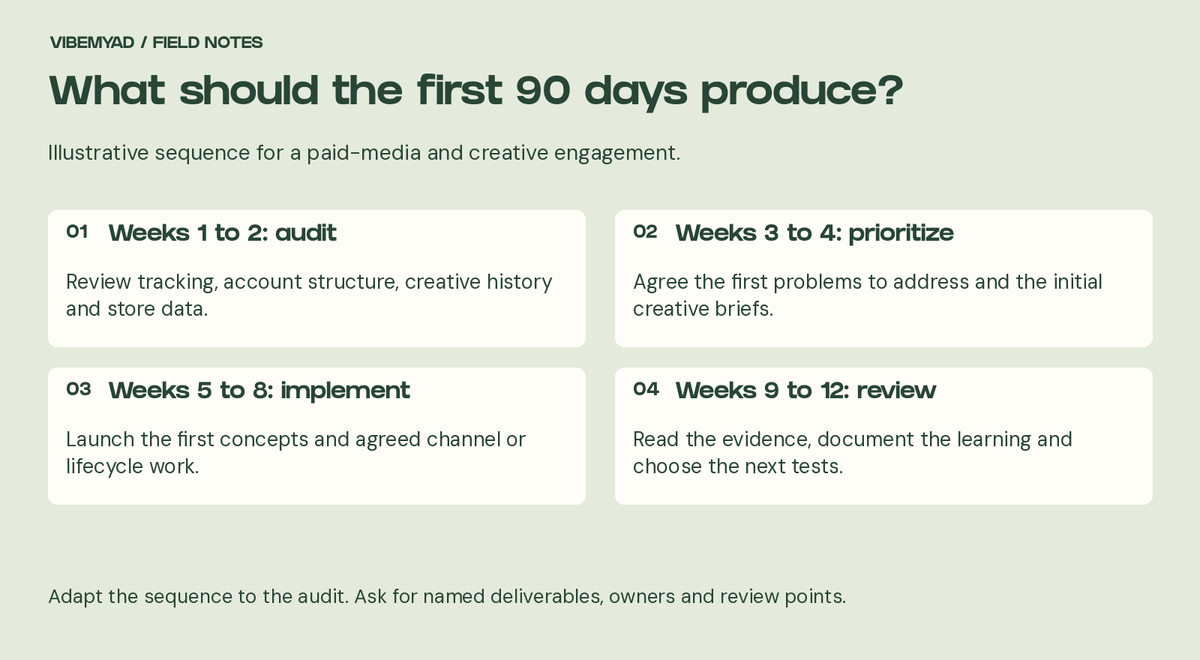
Illustrative first 90 days: audit in weeks 1 to 2, prioritize in weeks 3 to 4, implement in weeks 5 to 8 and review in weeks 9 to 12.
The strongest questions reveal process, ownership, scope, and accountability:
• Ask what they do before they make anything. A useful answer names the customer, competitor, performance, search, or category inputs that shape the plan.
• Ask for the scope in writing, including deliverables, cadence, exclusions, and who owns each part.
• Ask what a disappointing first month would trigger: what gets reviewed, what can change, and what cannot yet be judged.
• Ask who will actually do the work and how much senior involvement you should expect after the pitch.
• Ask for relevant proof. A case study or reference should match the channel, business stage, and problem you are hiring for.
• Ask what the reporting shows and how often. A useful report connects ad spend to Shopify orders, not just platform metrics. Ask whether it explains differences between what the ad platform reports and what the store actually shipped. If the answer is a templated dashboard, ask who interprets it and when.
• Ask what is explicitly excluded from scope. Development work, landing page builds, additional creative above the monthly limit, and extra revision rounds are common exclusions that appear later as separate invoices. Get the exclusions list before you sign, not after the first out-of-scope request arrives.
• Ask about contract terms, notice periods, account ownership, and offboarding. Know what you keep and how quickly access changes if the engagement ends.
For a more detailed evaluation script, see our nine questions for choosing an ecommerce marketing agency.
Vibemyad is an AI-native marketing agency focused on US DTC and ecommerce brands. For paid acquisition, our commercial service combines ad research, creative production, Meta campaign management, testing, and measurement. You can review that model on our Meta ads agency page.
• Research supports the work. Internal ad-intelligence tools help our team study live category advertising and organize patterns by hook, format, offer, and funnel stage. The client is buying the agency service and decisions, not access to a software product.
• We deliver finished work. The goal is usable creative, campaigns, analysis, and recommendations rather than raw AI output that the client has to finish.
• Commercial terms are outcome-oriented and month to month. The exact scope depends on the engagement, and the client keeps its accounts and delivered assets.
• We are not a Shopify development agency. Replatforming, checkout engineering, and complex custom development should be scoped with the right technical partner rather than disguised inside a marketing engagement.
What our clients say, in their words rather than ours. BestLanding: four days from the first call to ads running, and conversions up 28% after we applied one pattern their founder had spotted. Teak & Torch: cost per lead down 62% in six weeks, plus 3D try-ons now used by about 32% of their site visitors. Noise, on the in-house question: more finished work in a week than their studio shipped in a month, and they shelved plans for a second designer.
What to take from all of this:
• Name the constraint before you shortlist. Store engineering, paid acquisition, retention, search, and creative problems require different capabilities.
• Compare scope and incentives, not only the monthly fee. The commercial model matters, but so do the outputs and responsibilities attached to it.
• Ask what evidence changes the next decision. A useful agency process should connect research and performance to the next piece of work.
If Meta and creative are the current growth constraints, see Vibemyad's Meta ads agency service for how we structure research, production, campaign management, testing, and measurement.
Related: see Vibemyad's Meta ads agency service, learn how to choose an ecommerce agency, compare ecommerce agency costs, or read our Shopify marketing agency and Shopify ads agency guides.


Arpita Mahato
Content Writer, Vibemyad

Arpita Mahato
Content Writer, Vibemyad

Arpita Mahato
Content Writer, Vibemyad
Table of Contents